
This post contains affiliate links.
Published: June 11, 2026 · ⏱ 9 min read · Ustadah Ayesha Siddiqua, Female Quran Tutor
Every Muslim parent wants to teach their child the Quran. But many are unsure where to start, what they can reasonably do without formal training, and whether their own imperfect recitation will do more harm than good.
This guide answers those concerns honestly. It tells you exactly what you can do at home — stage by stage — and where the limits of home teaching are, so you know when a qualified teacher becomes necessary.
What Parents Can Realistically Do at Home
Let us start with an honest assessment. A parent without formal Tajweed training can:
- Create a Quran-rich home environment through recitation and listening
- Teach short Surahs for Salah by repetition
- Introduce basic Arabic letters using a Qaida book
- Listen to and encourage daily revision between teacher-led classes
- Build the habit, routine, and love for Quran that makes formal learning effective
A parent without formal Tajweed training cannot reliably:
- Identify and correct their child’s Tajweed errors
- Ensure letters are produced from their correct articulation points
- Apply rules of Noon Sakinah, Madd, Qalqalah consistently during correction
- Provide structured progression through a complete Quran reading curriculum
This is not a criticism. It is simply honest. The parent’s role and the teacher’s role are complementary — and both are essential. A child with an involved parent and a qualified teacher progresses faster than one with only a teacher. But a child with only a parent risks building on an incorrect foundation.
Stage 1: Before Age 5 — Exposure and Environment
The most powerful thing you can do before any formal learning begins is make the Quran a natural part of your child’s sonic environment. Children absorb language — including Arabic — passively, before they can consciously process it. What they hear repeatedly becomes familiar. What is familiar becomes learnable.
What to do at this stage:
- Play Quran recitation softly in the home — during mealtimes, before naps, in the car. Use a clear, accurate reciter: Sheikh Mahmoud Khalil al-Husary (slow/Tajweed) or Sheikh Abdul Rahman Al-Sudais are widely recommended for young children.
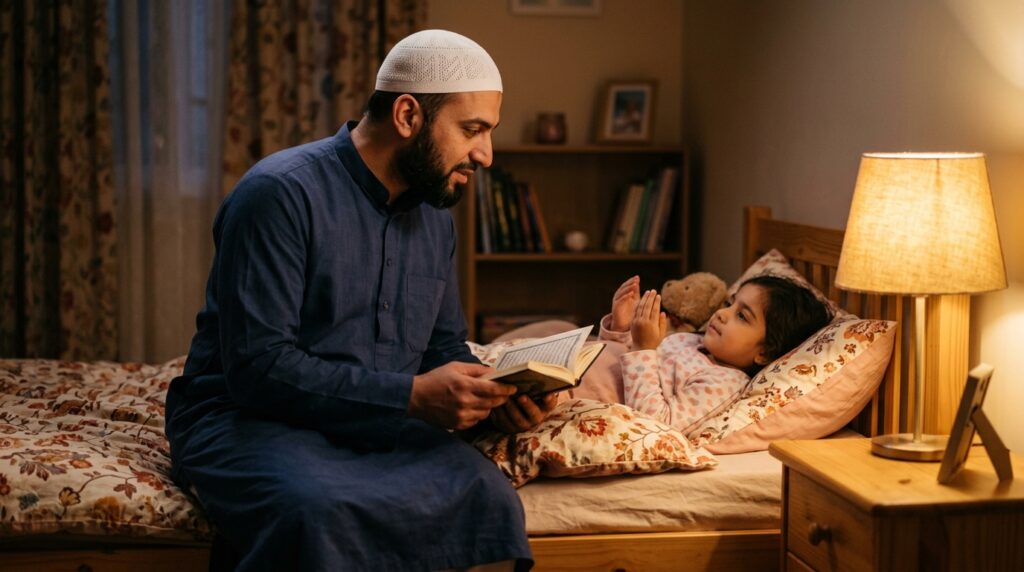
- Recite short Surahs to your child as part of bedtime — Al-Ikhlas, Al-Falaq, An-Naas, the last two verses of Al-Baqarah. Recite slowly, clearly, and repeatedly.
- Say Bismillah together before meals and activities. Say Alhamdulillah when something good happens. These short phrases, repeated daily, become the child’s first Quranic vocabulary.
- Have a Quran visibly present in the home — not locked away, not treated as untouchable. A child who sees a Quran as a familiar, beloved object approaches learning it differently from one who encounters it only in formal settings.
What not to do: Do not begin formal letter drills before age 4-5. Children at this stage learn through hearing and repetition, not instruction. Forcing structured sessions before a child is developmentally ready creates resistance that can take months to undo.
Stage 2: Ages 5–7 — First Structured Learning
At this stage, most children can begin to sit and focus for 15-20 minutes. This is when home learning can become more structured — and when a qualified teacher becomes genuinely valuable.
What parents can do at home:
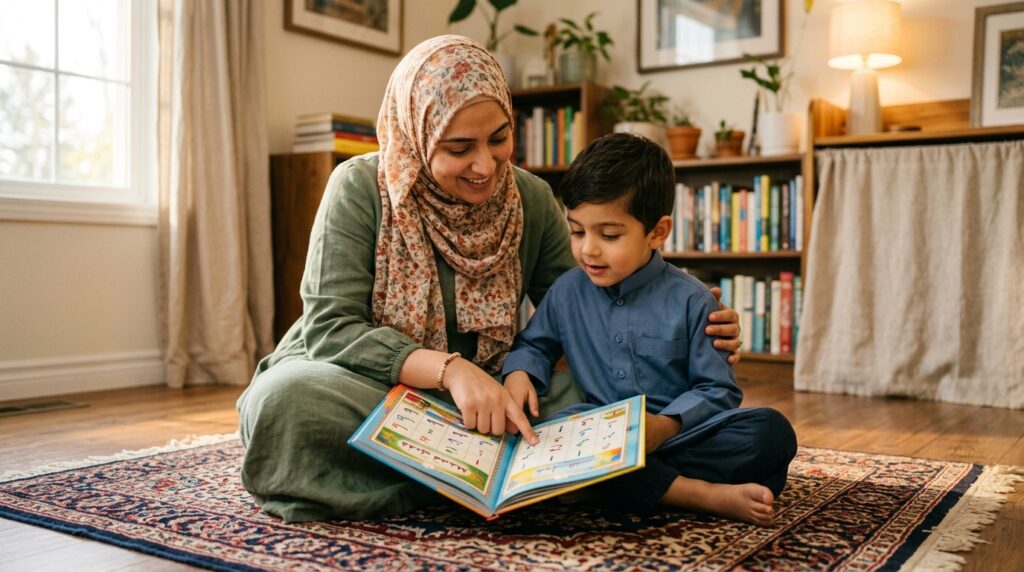
Teach the Arabic alphabet from a Qaida. If you can read Arabic yourself — even imperfectly — you can introduce your child to Arabic letters using a Madani Qaida or Noorani Qaida. Sit together for 10-15 minutes daily. Show the letter, say its name, make its sound, ask the child to repeat. Cover 2-3 new letters per session maximum. Review previously learned letters at the start of each session.
A caution: if your own Arabic reading is uncertain, be careful about teaching letter sounds — errors you teach now will need to be un-taught later. Consider this an introductory exposure, not formal instruction, and pair it with a qualified teacher who will confirm and correct.
Teach short Surahs by repetition. Choose the Surahs your child will use in Salah. Recite one verse, ask the child to repeat. Do this for 5 minutes daily, focusing on one Surah at a time until it is solid before moving to the next. The sequence most teachers recommend: Al-Fatiha → Al-Ikhlas → Al-Falaq → An-Naas → Al-Asr → Al-Kawthar.
Listen to your child’s revision. If your child is attending classes with a qualified teacher, ask the teacher what was covered and listen to your child recite it back at home. You do not need to correct — you need to be present and attentive. The act of reciting to a listening adult strengthens retention significantly.
Enrol with a qualified teacher. By age 5-6, most children benefit enormously from a qualified one-on-one teacher who can assess their level, introduce a structured curriculum, and correct what you cannot. Home learning and teacher-led learning are not competing choices — they work best together. The teacher provides instruction and correction; the home provides revision and habit.
Looking for a qualified teacher to complement home learning?
Book a free trial class at Suffah Quran Academy. Our teachers work with children from age 4 — and will tell you honestly what your child needs and where to begin.
Book Free Trial Class →Stage 3: Ages 7+ — Supporting a Qualified Teacher
By age 7 and above, most children are in structured Quran classes with a teacher. The parent’s role at home shifts from primary instructor to daily support — and this role, though less visible, is just as important.
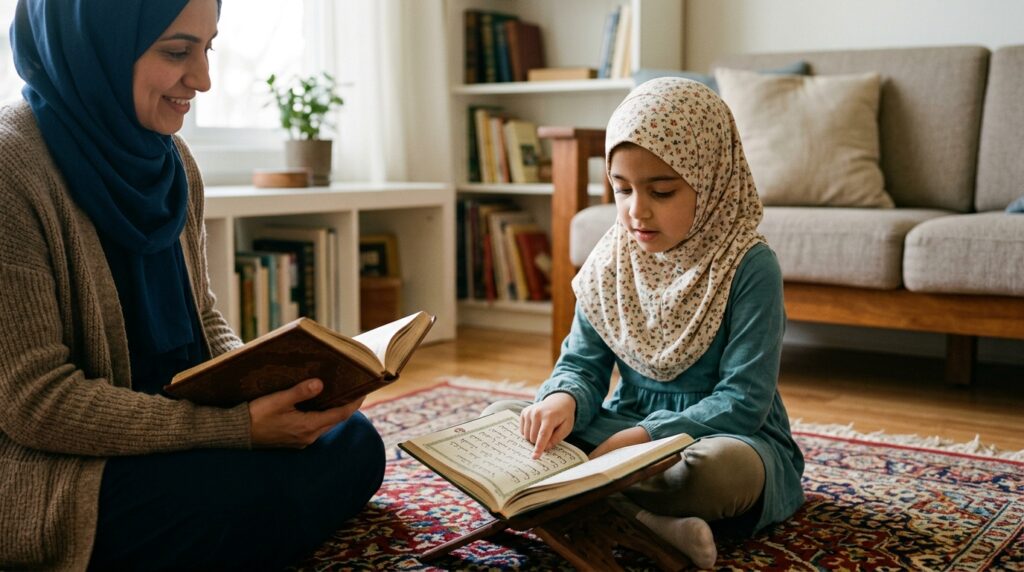
Daily revision listening. After each class, ask your child to recite what they covered. Follow along in the Mushaf or Qaida while they recite from memory or read. You do not need to correct every error — your presence and attention are the valuable things. If you notice something that sounds clearly wrong, note it and mention it to the teacher.
Protect the Quran time. As children get older, other commitments multiply — school, sports, social activities. The parent’s job is to ensure the Quran slot in the weekly routine is protected. Not every week is perfect. But the default should be that Quran classes happen, and missing them requires a reason, not the other way around.
Stay in communication with the teacher. Ask monthly: what is my child working on, where are they strong, what should we focus on at home this week? A good teacher will have specific, useful answers. Using those answers makes the home practice targeted rather than generic.
Integrate Quran into Salah. Encourage your child to use their newly memorised Surahs in their daily prayers — not always the same three they know by heart, but the ones they have been learning recently. This practice embeds new memorisation in a way that repetition alone does not.
Building a Daily Quran Routine That Sticks
The most common reason home Quran learning breaks down is not lack of effort — it is lack of structure. A routine that happens at the same time every day, attached to an existing habit, requires far less willpower to maintain than one that happens “whenever there is time.”
Three times that work reliably for most families:
- After Fajr. The house is quiet, the mind is fresh, the day has not yet made its demands. Even 10 minutes of Quran after Fajr — before screens, before breakfast, before everything else — establishes the Quran as the foundation of the day.
- After school, before other activities. The window between school arrival and the first screen or activity is often the best opportunity of the afternoon. 15-20 minutes of Quran before anything else makes it the priority rather than the afterthought.
- Before bed. Short Surah recitation together before sleep — Al-Ikhlas, Al-Falaq, An-Naas, Ayatul Kursi — is a practice from the Sunnah and a natural, calm way to end the day with the Quran.
Pick one. Keep it. Consistency in one slot beats inconsistency in three.
Which Surahs to Teach First
For parents teaching Surahs at home, this sequence — from shortest to slightly longer, all essential for Salah — is what most qualified teachers recommend for beginners:
| Order | Surah | Verses | Why First |
|---|---|---|---|
| 1 | Al-Fatiha | 7 | Required in every rakat of Salah |
| 2 | Al-Ikhlas | 4 | Short, frequently recited, profound meaning |
| 3 | Al-Falaq | 5 | One of the Mu’awwidhatayn — morning/evening protection |
| 4 | An-Naas | 6 | Pair with Al-Falaq — both memorised together |
| 5 | Al-Asr | 3 | Very short, profound, Imam Shafi described it as summarising the Quran |
| 6 | Al-Kawthar | 3 | Shortest Surah — easy early win |
| 7 | Al-Fil | 5 | Slightly longer — builds memorisation capacity |
Common Mistakes Parents Make
Teaching incorrect pronunciation. If you are unsure of a sound, check a recording before teaching it. Saying “it’s roughly like this” and teaching an approximation is better than confidently teaching an error. For letters you are uncertain about — Ain, Haa, Qaaf — it is better to say “the teacher will show you how this one sounds” than to teach it incorrectly.
Correcting the teacher’s corrections. Occasionally a child comes home saying “but you say it differently.” If a qualified teacher has corrected your child’s pronunciation of a letter, trust the teacher. Your recitation may have an error you are not aware of. This is not a criticism — it is why qualified teachers exist.
Making Quran time a battleground. Forcing a child through a Quran session when they are resistant, tired, or upset produces resentment — toward the parent, the session, and eventually the Quran itself. When resistance happens, shorten the session, lower the expectation, and end positively. Tomorrow is another chance. Read our guide on making Quran learning positive for more on this.
Starting and stopping repeatedly. Many families begin Quran at home enthusiastically, lose momentum after a few weeks, restart, lose it again. Inconsistency is more damaging than slow progress. A small daily habit — 10 minutes — maintained across months produces far more than occasional intense sessions followed by long gaps.
Waiting until the child is “ready.” The perfect moment to begin exposure never arrives. There is no age at which a child is suddenly ready for the Quran to be present in their life. Begin creating the environment today — the readiness develops within it.
When to Get a Qualified Teacher
If you are asking this question, the answer is probably: now.
Specifically, a qualified teacher becomes necessary when:
- Your child is ready to begin structured Arabic letter learning (age 5+)
- Your child can read some Arabic but you are not sure if it is correct
- Your child has been learning at home but progress has stalled
- You want your child to read the Quran — not just recite memorised Surahs — with correct Tajweed
- You are considering Hifz — a qualified Hifz teacher is absolutely necessary, not optional
A qualified teacher does not replace what you do at home. They provide what you cannot provide — formal correction, structured curriculum, verified Tajweed — and everything you do at home makes their work more effective.
The two roles together produce the best outcomes. Neither alone is complete.
Frequently Asked Questions
Yes — to a meaningful extent. Parents can teach short Surahs for Salah, create a Quran-rich home environment, and support daily revision. However, for correct Tajweed and structured progression, a qualified teacher is necessary. The parent’s home role and the teacher’s instruction role work best together.
Exposure — playing Quran recitation, reciting short Surahs together — can begin from birth. Structured home sessions with a Qaida book work from age 4-5. Formal teacher-led classes are most effective from age 5-7 for most children.
Begin with Surahs used in Salah: Al-Fatiha, Al-Ikhlas, Al-Falaq, An-Naas, Al-Asr, Al-Kawthar, Al-Fil. Teach by repetition — recite once, child repeats. Short daily sessions of 5-10 minutes are more effective than long occasional ones.
Without formal Tajweed training, you may not identify all errors. The best approach is to combine home support with a qualified teacher who provides professional correction. Your role is to listen, encourage, and maintain the habit — the teacher ensures accuracy.
Ages 4-5: 10-15 minutes maximum. Ages 6-7: 15-20 minutes. Ages 8-10: 20-25 minutes. Always end while the child still has energy — a session ending positively is more valuable than a longer session that exhausts the child.
You Are Already Doing More Than You Think
If you are reading this guide, you are already the kind of parent who thinks carefully about their child’s Quran education. That intention — and the consistent small actions that follow from it — is more than most children receive.
The Quran-rich home environment you create, the Surahs you recite together before bed, the 10 minutes of revision you sit through every evening — these are the invisible foundations that make everything a teacher does in class more effective.
Your role is irreplaceable. And combining it with a qualified teacher’s role gives your child the best possible start.
Add a Qualified Teacher to What You Are Already Doing
Book a free trial class at Suffah Quran Academy. Our teachers work with parents — keeping you informed and involved throughout your child’s learning journey.
Book Free Trial Class →
Written by Ustadah Ayesha Siddiqua
Female Quran Tutor · 5 Years Experience · Noorani Qaida, Nazra Quran · Urdu, Hindi, English
Ustadah Ayesha teaches Noorani Qaida, Quran reading, and Islamic manners for children and sisters. She is known for her calm and encouraging teaching style, and works closely with parents to ensure home learning and classroom learning reinforce each other.
Meet our teaching team →