

This post contains affiliate links.
Estimated reading time: 12 minutes
Table of contents
- What Is Noon Sakinah?
- What Is Tanween?
- Why Are They Governed by the Same Rules?
- Overview: The Four Rules at a Glance
- Rule 1: Izhar — Clear Pronunciation (إظهار حلقي)
- Rule 2: Idghaam — Merging (إدغام)
- Rule 3: Iqlaab — Substitution (إقلاب)
- Rule 4: Ikhfaa — Concealment (إخفاء حقيقي)
- How to Identify the Correct Rule — A Step-by-Step Process
- Practice: Which Rule Applies?
- A Note on Learning These Rules in Practice
- Frequently Asked Questions
If you have started learning Tajweed, you have almost certainly encountered the rules of Noon Sakinah and Tanween. They are the rules that appear most frequently in the Quran — and therefore the ones that matter most to get right.
Many learners find these rules confusing at first — not because they are inherently difficult, but because they are often taught with too many Arabic terms at once, without a clear structure to hold them together.
This guide takes a different approach. It explains each of the four rules in plain language, gives you real examples from the Quran, provides memory tips that actually work, and tells you exactly which letters trigger each rule — so you know what to look for when you are reading.
By the end of this guide, you will have a complete, usable understanding of every Noon Sakinah and Tanween rule.
What Is Noon Sakinah?
Noon Sakinah (نْ) is the letter Noon (ن) with a Sukoon — the small circle (ْ) that indicates the letter has no vowel and makes no independent vowel sound. It is a “stopped” or “resting” Noon.
You will find Noon Sakinah:
- In the middle of a word: مِنْكُمْ (from you) — the Noon before Kaaf
- At the end of a word: مَنْ (whoever) — the final Noon before the next word begins
What Is Tanween?
Tanween (تنوين) refers to the double vowel marks that appear at the ends of Arabic words. These double marks produce an “n” sound when recited:
- Fathatayn (ـً) — double Fathah — produces an “-an” sound: كِتَابًا (kitaaban)
- Kasratayn (ـٍ) — double Kasrah — produces an “-in” sound: كِتَابٍ (kitaabin)
- Dammatayn (ـٌ) — double Dhammah — produces an “-un” sound: كِتَابٌ (kitaabun)
Why Are They Governed by the Same Rules?
Noon Sakinah and Tanween are treated together because they produce the same sound — an “n” at the end of a syllable. The rules that apply to a Noon Sakinah in the middle of a word are the same rules that apply to Tanween at the end of a word, because the sound that needs to be governed is identical in both cases.
There are four rules — and which rule applies depends entirely on the letter that comes immediately after the Noon Sakinah or Tanween.
Overview: The Four Rules at a Glance
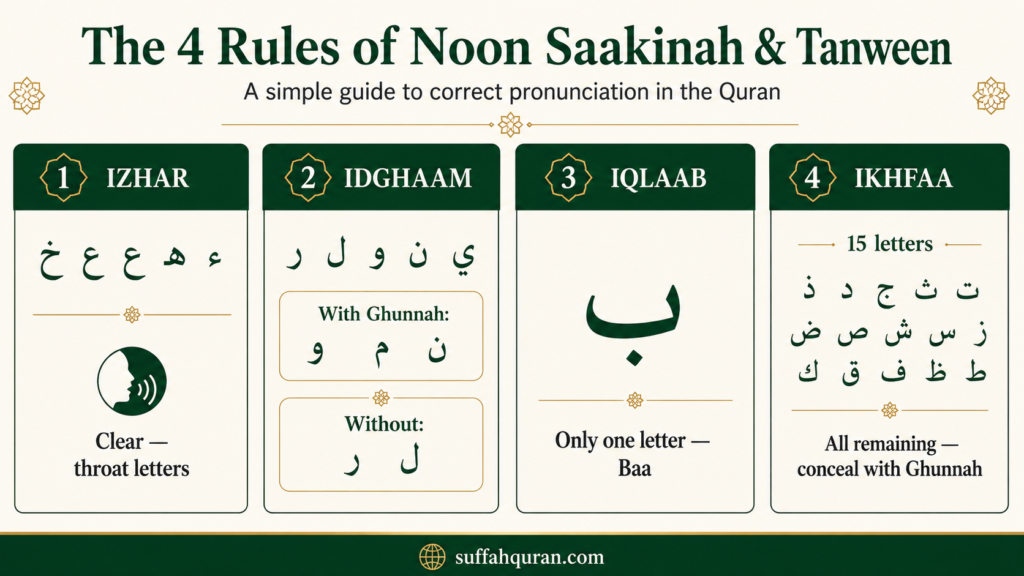
Before going deep into each rule, here is the complete picture in one place:
| Rule | Arabic | What Happens | Triggered By |
|---|---|---|---|
| Izhar | إظهار | Noon pronounced clearly | 6 throat letters: ء ه ع ح غ خ |
| Idghaam | إدغام | Noon merges into next letter | 6 letters: ي ر م ل و ن |
| Iqlaab | إقلاب | Noon changes to Meem sound | 1 letter only: ب |
| Ikhfaa | إخفاء | Noon partially concealed | 15 remaining letters |
Note: Together, the Izhar letters (6) + Idghaam letters (6) + Iqlaab letter (1) + Ikhfaa letters (15) = 28 letters. This covers all Arabic letters except Noon itself (which triggers Idghaam of the same letter — a special case covered below).
Rule 1: Izhar — Clear Pronunciation (إظهار حلقي)
What it means: Izhar means to make clear or to display. When Noon Sakinah or Tanween is followed by one of the six Izhar letters, the Noon is pronounced completely and clearly — no merging, no concealment, no extension.
The 6 Izhar letters — all produced from the throat (hence “Halqi” — حلقي meaning throat): ء (Hamzah) · ه (Ha) · ع (Ain) · ح (Ha) · غ (Ghain) · خ (Kha)
A useful memory tool: these are the six letters that start the Arabic phrase أَخِي هَاكَ عِلْمًا حَازَ غَيْرَ خُسْرٍ — but simply remembering the six shapes is more practical for most learners.
What it sounds like: The Noon is fully pronounced before moving to the next letter. There is a brief, complete “n” sound.
Quran examples:
مِنْ عِلْمٍ — (min ‘ilmin) — Noon before Ain: pronounced clearly. “min — ‘ilmin” أَنْعَمْتَ — (an’amta) — Noon before Ain: clear Noon. “an-‘amta” مَنْ آمَنَ — (man amana) — Noon before Hamzah: complete Noon sound.
Common mistake: Some learners extend a nasal sound (Ghunnah) before throat letters. Izhar requires no Ghunnah — the Noon is clean and clear.
Rule 2: Idghaam — Merging (إدغام)
What it means: Idghaam means to merge or to insert one thing into another. When Noon Sakinah or Tanween is followed by one of the six Idghaam letters, the Noon sound disappears — it merges completely into the following letter.
The 6 Idghaam letters: ي ن م و ل ر Often remembered by the Arabic word يَرْمَلُونَ or the phrase يَرْمَلُ وَنُون.
Idghaam has two types depending on whether a nasal sound (Ghunnah) accompanies the merger:
Idghaam with Ghunnah (إدغام بغنة)
Letters: ي · ن · م · و (Ya, Noon, Meem, Waw) The Noon merges into the following letter AND a nasal Ghunnah sound is held for approximately 2 counts.
Quran examples:
مِنْ يَوْمٍ — (min yawmin) — Noon before Ya: merges with Ghunnah. Do not say “min-yawm” with a clear N; the N dissolves. مِنْ وَلِيٍّ — (min waliyyin) — Noon before Waw: Ghunnah present.
Idghaam without Ghunnah (إدغام بغير غنة)
Letters: ل · ر (Lam, Ra) The Noon merges into the following letter WITHOUT any nasal sound. The merger is complete and immediate.
Quran examples:
مِنْ رَبِّكَ — (min rabbika) — Noon before Ra: complete merger, no nasal sound. Sounds like “mir-rabbika.” مِنْ لَدُنْهُ — (min ladunhu) — Noon before Lam: full merger, clean.
Important exception: Idghaam does NOT apply when the Noon Sakinah and the following Idghaam letter are in the SAME word. In these cases, the Noon is pronounced clearly (Izhar), to prevent distorting the word. Examples of words where this applies: دُنْيَا (dunya — Noon before Ya, same word), قِنْوَانٌ (Noon before Waw, same word), صِنْوَانٌ, بُنْيَانٌ.
Rule 3: Iqlaab — Substitution (إقلاب)
What it means: Iqlaab means to flip or to substitute. When Noon Sakinah or Tanween is followed by the letter Baa (ب), the Noon sound changes to a Meem (م) sound — and a Ghunnah is held while the lips gently close.
The 1 Iqlaab letter: ب (Baa) — this is the only letter that triggers this rule.
What happens physically: The tongue does not go to the position for Noon. Instead, the lips come together gently (as they would for Meem), and a nasal Meem-like sound is produced with Ghunnah, for approximately 2 counts.
Why does Iqlaab exist? The Noon sound and the Baa sound are produced from completely different parts of the mouth — Noon from the nasal passage and front of the mouth, Baa from the lips. Transitioning directly from a complete Noon to a Baa creates an awkward collision of articulation points. The scholars of Tajweed identified this and codified Iqlaab as the correct solution.
Quran examples:
مِنْ بَعْدِ — (mim ba’di) — Noon before Baa: becomes a Meem sound. Hear it as “mim-ba’di.” أَنْبِئْهُمْ — (ambihim) — Noon before Baa: the Noon is replaced by a nasal Meem with lips gently closed. سَمِيعٌ بَصِيرٌ — Tanween before Baa: the “-un” ending becomes a nasal Meem sound.
Memory tip: Iqlaab = only Baa. One letter. One rule. If you see Noon Sakinah or Tanween followed by Baa — always Iqlaab. No exceptions.
In the Mushaf: Some Mushafs mark Iqlaab with a small Meem (م) written above the Noon or Tanween — a visual reminder that the sound changes to Meem.
Rule 4: Ikhfaa — Concealment (إخفاء حقيقي)
What it means: Ikhfaa means to hide or conceal. When Noon Sakinah or Tanween is followed by any of the 15 Ikhfaa letters, the Noon is neither fully pronounced (as in Izhar) nor fully merged (as in Idghaam). It is concealed — a nasal sound that exists between the two extremes.
The 15 Ikhfaa letters: ص · ذ · ث · ك · ج · ش · ق · س · د · ط · ز · ف · ت · ض · ظ
A traditional way to remember them: these are the letters of the sentence: صِفْ ذَا ثَنَا كَمْ جَادَ شَخْصٌ قَدْ سَمَا … دُمْ طَيِّبًا زِدْ فِي تُقًى ضَعْ ظَالِمًا
What it sounds like: The tongue does not fully touch the articulation point of the Noon — so the Noon sound is not complete. Instead, a nasal resonance (Ghunnah) is held for approximately 2 counts while the mouth moves toward the position of the following letter. The result is a sound that is somewhere between a clear Noon and a full merger.
What it looks like physically: The tongue is raised toward (but not touching) the roof of the mouth. The sound comes through the nasal passage. The lips and tongue are beginning to move toward the position of the following letter while the nasal sound continues.
Quran examples:
مِنْ كُلِّ — (Noon before Kaaf): Ikhfaa. The Noon is concealed; a nasal sound transitions into the Kaaf. مِنْ شَيْءٍ — (Noon before Sheen): Ikhfaa with nasal quality. عَلِيمٌ خَبِيرٌ — (Tanween before Kha): the “-un” ending goes into Ikhfaa before Kha. أَنْتَ — (Noon before Ta): Ikhfaa — very common in the Quran.
Why is Ikhfaa the most common rule? Because 15 out of 28 remaining Arabic letters trigger it. In any given page of Quran, Ikhfaa will appear more frequently than all other Noon Sakinah rules combined.
Common mistake: Many learners either pronounce a full clear Noon (treating it as Izhar) or merge it completely (treating it as Idghaam). Ikhfaa is neither — it is the middle state, with Ghunnah, the tongue not completing the Noon, and the sound transitioning nasally.
How to Identify the Correct Rule — A Step-by-Step Process
When you encounter Noon Sakinah or Tanween in recitation, follow this sequence:
Step 1: Look at the letter immediately following the Noon Sakinah or Tanween.
Step 2: Ask — is it one of the 6 throat letters (ء ه ع ح غ خ)? → Izhar (clear)
Step 3: If not — is it one of the 6 Idghaam letters (ي ن م و ل ر)? → Idghaam (merge — with or without Ghunnah depending on the letter)
Step 4: If not — is it Baa (ب)? → Iqlaab (change to Meem sound)
Step 5: If none of the above — it is one of the 15 Ikhfaa letters → Ikhfaa (conceal with Ghunnah)
This process takes seconds once the letters are memorised. With practice, the rule becomes instinctive — the correct sound comes automatically when the eye identifies the following letter.
Practice: Which Rule Applies?
Work through these examples before reading the answers:
- مِنْ حَيْثُ — Noon before ح (Ha) → ?
- مِنْ قَبْلِ — Noon before ق (Qaaf) → ?
- وَاللَّهُ سَمِيعٌ بَصِيرٌ — Tanween before ب (Baa) → ?
- إِنْ يَّشَأْ — Noon before ي (Ya) → ?
- مَنْ آمَنَ — Noon before ء (Hamzah) → ?
Answers:
- Izhar (Ha is a throat letter)
- Ikhfaa (Qaaf is one of the 15 Ikhfaa letters)
- Iqlaab (Tanween before Baa — the only Iqlaab trigger)
- Idghaam with Ghunnah (Ya is an Idghaam letter — with Ghunnah group)
- Izhar (Hamzah is a throat letter)
A Note on Learning These Rules in Practice

Understanding the rules intellectually — knowing which letter triggers which rule — is a necessary first step. But applying them correctly during actual recitation is a different skill, developed through practice with a teacher who can hear you and correct you in real time.
The most common patterns to work on with a teacher:
Ikhfaa — ensuring the Noon is genuinely concealed (not fully pronounced, not fully merged) and the Ghunnah duration is correct.
Idghaam with and without Ghunnah — distinguishing clearly between the two types, especially for Lam and Ra (no Ghunnah) versus Ya, Waw, Meem, Noon (with Ghunnah).
Iqlaab — ensuring the lips actually close gently (as they do for Meem) rather than remaining open, and that the Ghunnah is present.
Written rules can be read anywhere. Correct application requires a qualified teacher listening to your recitation.
Our Ijazah-certified teachers at Suffah Quran Academy teach Tajweed with live correction — book a free trial class to experience the difference between reading about rules and having them corrected in real time.
For the complete list of all Tajweed rules, see our Tajweed Rules Reference for Beginners. Once the theory here feels solid, our Noon Sakinah & Tanween practice exercises walk through drill words and a daily routine for turning these four rules into automatic habit.
Frequently Asked Questions
In Idghaam, the Noon disappears completely — it fully merges into the following letter with no remaining Noon sound. In Ikhfaa, the Noon is partially present — concealed but not gone. A nasal Ghunnah resonates for approximately 2 counts, and the tongue does not complete the Noon’s articulation point. The result is a sound between a clear Noon and a full merger.
No — this is an important exception. When the Noon Sakinah is in the same word as the following Idghaam letter, Izhar (clear pronunciation) applies instead. This prevents the word from being distorted. This exception applies only to four words in the Quran: دُنْيَا، قِنْوَانٌ، صِنْوَانٌ، and بُنْيَانٌ.
They produce the same sound and are governed by the same four rules, but they are technically different. Noon Sakinah is a written letter — you see it on the page with a Sukoon. Tanween is a pronunciation feature — it is represented by doubled vowel marks and produces an “n” sound at the end of a word, but there is no actual Noon letter written.
Ikhfaa is by far the most frequent — appearing thousands of times, since 15 letters trigger it. Izhar and Idghaam are common but less frequent. Iqlaab is the rarest, since only one letter (Baa) triggers it — but it still appears several hundred times in the Quran.
You can study the rules from references like this one. But Tajweed is ultimately an oral tradition — the sounds must be heard and corrected, not just read about. A teacher who holds Ijazah has received the correct sounds through a verified chain of transmission and can identify errors in your application that you cannot identify yourself.