
This post contains affiliate links.
Estimated reading time: 12 minutes
Table of contents
The first class is always the one parents worry about most.
Will my child sit still? Will the teacher know how to handle a young child? Will the technology cooperate? What if my child gets nervous — or bored — or refuses to engage?
These are real concerns. And the best answer to all of them is preparation — knowing exactly what to expect, so that neither you nor your child is surprised.
This guide walks you through a first online Quran class from start to finish: what happens before the class, what happens during it, what a good teacher does in those first thirty minutes, and what you should do in the days after. By the end, you will know exactly what to look for — and what signals tell you that the teacher and programme are the right fit for your child.
Before the Class: Setting Up for Success
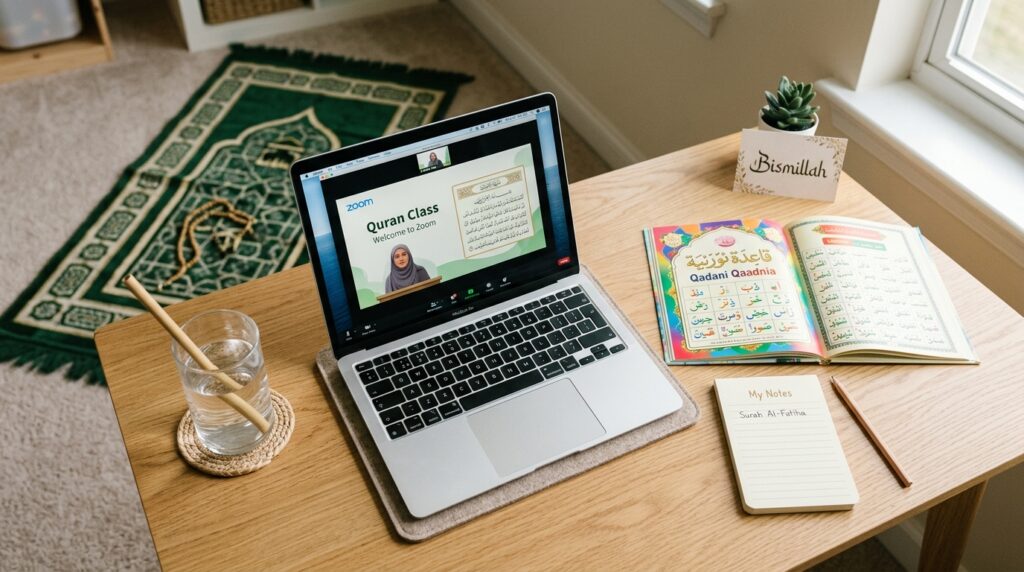
The first class goes better when the environment is prepared. These are not complicated requirements — but skipping any of them creates unnecessary friction.
The Technical Setup
Test everything the day before — not ten minutes before the class.
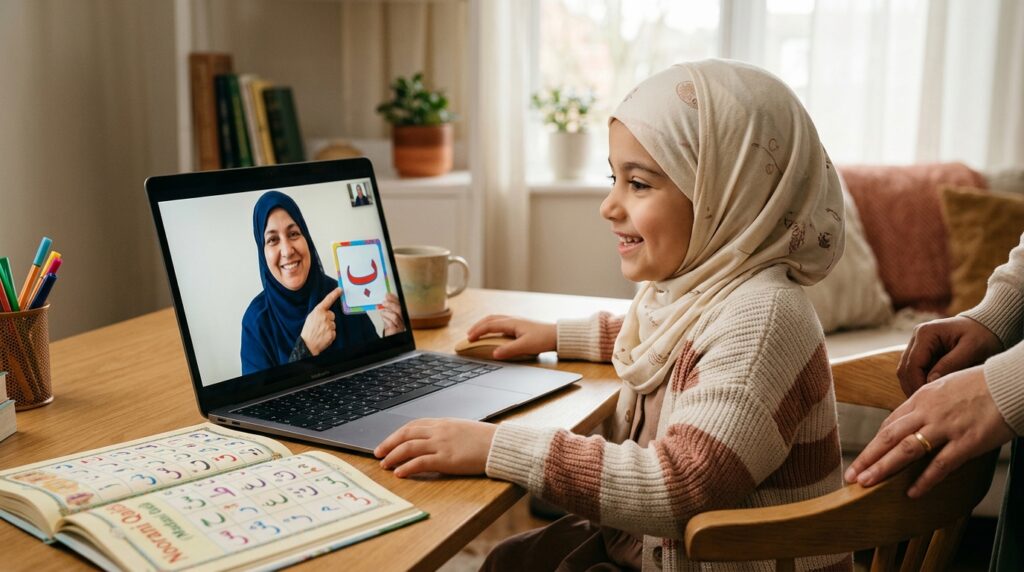
Device: A laptop or desktop computer is ideal for young children — larger screens mean the teacher’s face and the teaching materials are clearly visible. A tablet works too. A phone screen is too small for a young child to see properly during a Quran lesson.
Camera and microphone: The teacher needs to see your child’s face (to observe their mouth and expression) and hear their voice clearly (to correct pronunciation). Test both. If the microphone quality is poor, the teacher cannot hear recitation clearly enough to correct it accurately.
Internet connection: A stable connection matters more than speed. If your home Wi-Fi is unstable, connect the device to ethernet or position it close to the router. A class that freezes and cuts out every few minutes disrupts learning significantly.
Platform: Most online Quran teachers use Zoom or Skype. Make sure whichever platform is used is installed, tested, and the child knows how to unmute themselves.
The Physical Setup
A quiet space. The child needs to be in a room — or at least a corner — where background noise and interruptions are minimized. Siblings playing nearby, a television on in the background, or a parent having a phone call in the same room all make it harder for the child to focus and the teacher to hear.
A desk or table. The child should sit at a desk or table — not on a sofa or lying on a floor. Sitting at a desk signals that this is a structured activity, not casual screen time. It also makes it easier to hold and look at a book.
Good lighting. The child’s face should be well lit — ideally with natural light from in front, not from behind. A child sitting with a window behind them appears as a silhouette on the teacher’s screen, making it hard to see their face and mouth.
The Quran or Qaida book. Have the relevant material ready and open on the desk before the class begins. For a first class with a beginner, this will typically be the Madani Qaida. If you are not sure which book to have ready, ask the academy beforehand.
Preparing Your Child
Tell them what is going to happen — briefly and positively. “You are going to meet your new teacher on the screen. They are going to read some Arabic letters with you and ask you a few things. It will probably be fun.” Keep it calm. Do not oversell it with excessive enthusiasm, which can build pressure, or be so casual that the child does not take it seriously.
Do not force a pre-class performance. If your child has some Quran knowledge already, resist the urge to have them practice so they can “show off” to the new teacher. A good teacher will discover their level naturally in the session.
Sit nearby — but not in front of the screen. Younger children benefit from knowing a parent is present. You do not need to be on camera or involved in the session — simply being in the same room, close by, is usually enough to help a young child feel secure.
During the Class: What a Good First Session Looks Like
A well-structured first class with a qualified teacher follows a predictable pattern — not rigidly, but in terms of purpose and approach. Here is what to expect.
The First Few Minutes: Connection Before Content
A teacher who starts immediately with letters or recitation in the very first minute of a first class is skipping something important.
A good teacher will spend the first 3-5 minutes connecting with the child as a person — asking their name, their age, what they like doing, whether they have any brothers or sisters. This is not small talk. It is essential trust-building. A child who feels comfortable with the teacher will engage with the lesson. A child who feels like they are in front of a stranger will shut down.
Watch this first interaction carefully. How does the teacher speak to your child? Is the tone warm? Are they speaking at a level appropriate for your child’s age? Do they seem genuinely interested in the child, or are they rushing to get to “the lesson”? Your child’s first impression of the teacher is going to be largely accurate.
The Assessment: Understanding Where the Child Is
After the initial connection, the teacher will gently assess your child’s current level. This typically looks like:
For complete beginners (no Arabic knowledge): The teacher will introduce 2-3 Arabic letters — showing the shape, naming the letter, making the sound — and asking the child to repeat. They are observing: how quickly does the child absorb something new? How is their attention? Are they shy or outgoing with a new adult? How do they respond to gentle correction?
For children with some existing knowledge: The teacher will ask the child to read a few lines from their Qaida or Quran and listen carefully. They are assessing pronunciation accuracy, fluency, Tajweed awareness, and where any errors are occurring.
This assessment is not a test. There are no wrong answers. A child who does not know anything is exactly where a beginner should be. A child who has some knowledge but has errors is exactly where a child without formal Tajweed instruction would be. The teacher is simply gathering information to know how to help.
The First Actual Teaching
After assessment, a good teacher will introduce a small amount of new material — matched exactly to where the child is.
For a complete beginner, this typically means:
- 2-4 Arabic letters introduced individually
- Each letter named, shaped traced or described, and its sound demonstrated
- The child repeats the sound after the teacher
- The teacher corrects gently and specifically if the sound is not quite right
For a child who already knows the alphabet, the teacher might:
- Begin working through the first few pages of Madani Qaida
- Introduce vowel marks (harakat) with one or two letters
- Begin reading short vowelised Arabic syllables together
The amount covered in a first class is deliberately small. A good teacher does not try to impress parents by racing through material. They cover a small amount carefully, correctly, and confidently — leaving the child with the feeling that they have actually learned something, not been overwhelmed.
Correction in the First Class
Pay attention to how the teacher corrects your child’s mistakes. This is one of the most revealing things about a teacher’s approach.
Good correction looks like: “Almost — try it like this. Listen: baaaa. Now you try.” The teacher demonstrates the correct sound, gives the child another chance, and acknowledges when they get it right.
Problematic correction looks like: Moving past errors without comment (so errors become embedded), or correcting with exasperation or sharp tone (so the child becomes afraid to try).
In a first class, the best teachers correct patiently, specifically, and repeatedly — without making the child feel that making a mistake is something to be embarrassed about. The child should leave the first class with the understanding that mistakes are how you learn, not something to hide.
The Closing — What a Good Teacher Does at the End
A good teacher closes the first session with:
A brief summary: “Today we learned the letters Alif, Baa, and Taa. You did really well with Alif — it was very clear.”
A specific task for home: “Before your next class, practise these three letters with your parent — just five minutes is enough. Can you show me which three they are?” The child identifies the letters, which is itself a review activity.
A warm goodbye: The child should feel good about the experience — not just neutral. A teacher who ends with genuine warmth and a comment like “I am looking forward to our next class” sets the tone for the ongoing relationship.
After the Class: What to Do in the Next 24 Hours
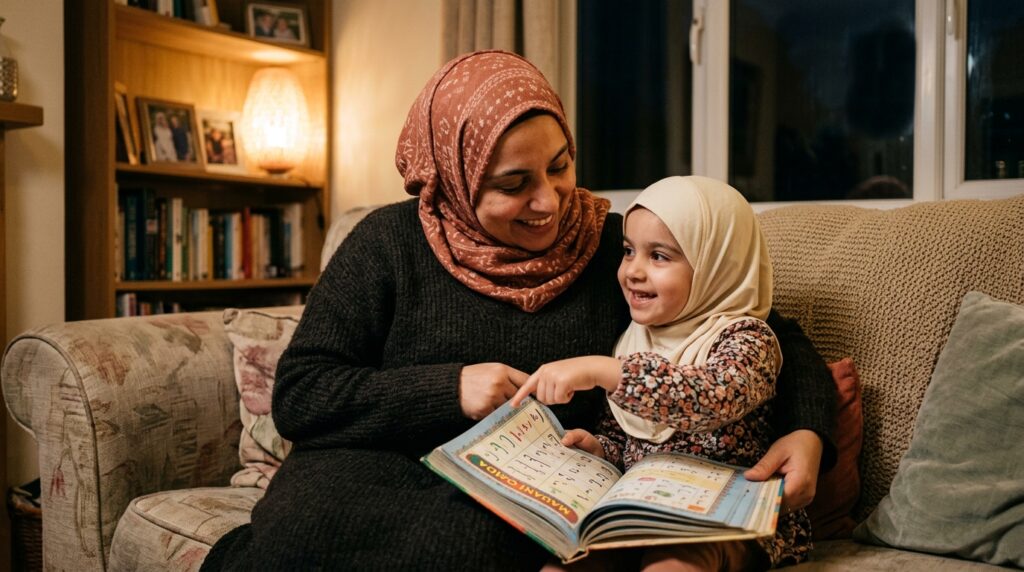
What happens in the 24 hours after a first class significantly affects how the second class goes.
Sit with your child and review what they learned. Ask them to show you the letters they learned. Let them teach you — children who explain what they learned retain it better. This does not need to be formal or long — five minutes on the sofa is enough.
Ask your child how they felt about the teacher. Not “did you like it?” which invites a yes/no. Ask: “What did you think of the teacher? What was your favourite part?” Their answer will tell you more than a thumbs up or thumbs down.
Note your own observations. You sat nearby (or watched a recording). Was the teacher patient? Did they correct clearly? Did your child seem comfortable or tense? Did the technology work smoothly? These first impressions are valuable data.
Communicate with the academy. If anything was unclear — which book to buy, how many sessions per week, what the schedule will be — this is the time to ask. A good academy responds to parent queries quickly and specifically.
What to Look For — Signs the First Class Went Well
Your child comes out of the class neutral-to-positive. Not necessarily bouncing with excitement (that is rare after a first class with a new adult) — but not distressed, not reluctant to talk about it, not saying they do not want to go back.
The teacher corrected at least once. A first class with zero corrections is a teacher who either did not listen carefully or decided to let errors pass. Neither is what you want from a Quran teacher.
Your child remembers something. They can show you one or two letters they learned. They can say the teacher’s name. Something was retained.
You felt the teacher’s warmth and competence. Trust your instincts. You were there. How the teacher spoke to your child, how they responded when something went wrong, how they ended the class — these things matter.
Signs to Pay Attention To
Your child says they felt scared or uncomfortable. One anxious first session is sometimes normal. Two in a row is a signal. Three is a pattern. Pay attention.
The teacher did not correct a single error. A teacher who simply confirms everything the child does as correct — even when the pronunciation is clearly wrong — is not qualified or not paying attention.
The teacher rushed through too much material. A first class that covers 15 letters with a 5-year-old, or races through pages of Qaida, is optimizing for the appearance of progress rather than actual learning.
The technology was so poor that the class was genuinely unusable. One technical glitch is normal. A class where the connection dropped every two minutes and the teacher seemed unable to troubleshoot it is a practical problem worth addressing before the next session.
Book a Free Trial — See This For Yourself
The best way to know what a first class looks like at Suffah Quran Academy is to experience one.
Our free trial class is a real class — not a sales presentation. Your child will meet the teacher they are likely to be assigned to. The teacher will assess their level, introduce a small amount of material, and give you a clear sense of the path forward.
After the class, we will talk with you about what we observed — your child’s current level, what the right starting point is, and what the journey will look like. No pressure. No obligation.
Book your child’s free trial class today → No payment. No commitment. Just a real first class with a real teacher.
Frequently Asked Questions
For young children (4-7 years), the first class is typically 20-30 minutes — short enough to maintain full attention, long enough to assess level, connect with the child, and introduce a small amount of material. For older children and adults, first sessions are typically 30-45 minutes.
For young children, being in the same room (out of camera view) helps them feel secure. Actively participating — answering for them, prompting them, or correcting them during the class — disrupts the teacher-student dynamic. Be present but quiet. For children aged 8 and above, many parents sit nearby without being in the same room, which is also fine.
Shyness in the first class is completely normal and a good teacher knows how to work with it — gently, without pressure, using a mix of observation and short questions that do not require long answers. Do not force engagement. Let the teacher handle it. If shyness persists across three or four sessions, discuss it with the teacher — there may be simple adjustments that help.
In most online Quran academies, teachers are referred to as “Ustadh” (for male teachers) or “Ustadha” (for female teachers) — the Islamic terms for teacher. Your child’s teacher will typically indicate their preferred form of address in the first class.
A first class is explicitly a trial. If the teacher does not feel like the right fit — for any reason — communicate that to the academy and request a different teacher. A good academy will accommodate this without making it uncomfortable. At Suffah, this is a normal part of the process.
For a free trial class, nothing needs to be purchased beforehand. The teacher will guide you on the specific Qaida or Quran edition to buy after the trial, once they have assessed your child’s level and confirmed the right starting point.