
This post contains affiliate links.
Published: October 14, 2026 · ⏱ 7 min read · Ustaz Ahmad Raza, Senior Quran & Tajweed Teacher
📖 In This Guide
- What Is Iqlab in Tajweed?
- Why Iqlab Is the “Odd One Out” of the Four Noon Sakinah Rules
- The Single Trigger Letter: Baa (ب)
- How the Sound Actually Changes: From Noon to Hidden Meem
- The Meem Sign in the Mushaf
- How Long to Hold the Ghunnah
- Iqlab in Real Ayahs (With References)
- Common Mistakes Beginners Make
- A 30-Second Self-Test
- FAQ
What Is Iqlab in Tajweed?
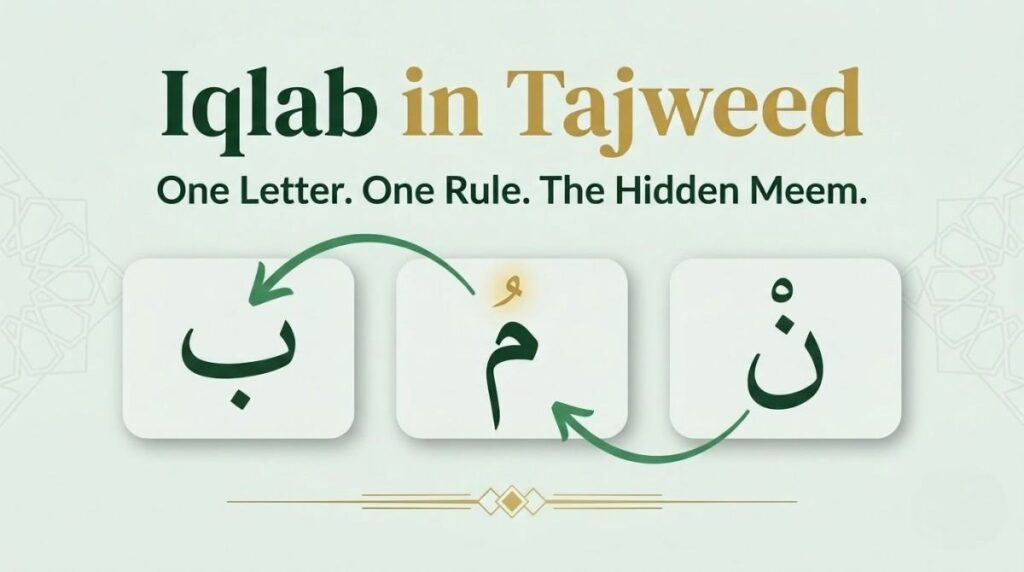
Iqlab (إقلاب) literally means “to convert” or “to turn something over.” In Tajweed, it’s the rule that applies when Noon Sakinah (نْ) or Tanween is immediately followed by the letter Baa (ب) — either within one word or across two words. Instead of pronouncing the Noon clearly, merging it away, or concealing it as a nasal Noon-sound, the Noon is converted into a hidden, nasalized Meem sound before the lips ease into the Baa.
This is one of the four outcomes covered in our full Noon Sakinah and Tanween rules guide — alongside Izhar, Idgham, and Ikhfa. Iqlab gets its own guide here because it’s the simplest of the four to describe (one letter, not six or fifteen) and yet one of the most commonly mispronounced, because the conversion happens entirely inside the mouth with almost no visual cue to copy from a teacher’s lips.
Why Iqlab Is the “Odd One Out” of the Four Noon Sakinah Rules
Seeing all four Noon Sakinah outcomes side by side makes it obvious why Iqlab doesn’t behave like the others:
- Izhar Halqi (clear pronunciation) — the Noon is pronounced fully, before the six throat letters.
- Idgham (merging) — the Noon’s sound disappears entirely into the next letter.
- Ikhfa (concealment) — the Noon is neither pronounced nor merged, but held as a nasalized hum.
- Iqlab (conversion) — the Noon doesn’t just change how it sounds; it’s actually replaced by a different letter’s sound (Meem) before the Baa is spoken.
Izhar, Idgham, and Ikhfa are all, in a sense, different ways of handling the same Noon. Iqlab is different in kind: the Noon is swapped for a Meem first, and only then does the usual Meem-before-Baa lip closure apply. That’s also why Iqlab has exactly one trigger letter instead of a list of six or fifteen — Baa is the only letter the lips need to prepare for Meem’s closure in advance of.
The Single Trigger Letter: Baa (ب)
Iqlab applies whenever Noon Sakinah or Tanween is directly followed by Baa (ب) — no other letter triggers it, and it doesn’t matter whether the Noon and the Baa sit inside one word or span two separate words in the recitation.
نْ / تنوين + ب ← Iqlab
Because it’s a single letter, students often assume Iqlab must be the easiest rule to apply correctly — and recognizing when it applies usually is. The actual mistake happens afterward, in execution: readers correctly spot the Baa, then either forget to convert the Noon at all, or convert it but press the lips shut too firmly, turning a Tajweed rule into an ordinary spoken Meem. The next two sections are about getting that execution right.
How the Sound Actually Changes: From Noon to Hidden Meem
When Iqlab applies, three things happen in quick succession:
- The Noon or Tanween is converted. Its sound is not pronounced as a Noon at all — it becomes a Meem sound before the Baa is reached.
- That Meem is held hidden, not open. The lips come together gently, without the firm pressure of a normal spoken Meem, while a nasal ghunnah (resonance through the nose) carries the sound.
- The lips ease into the Baa. Once the ghunnah finishes, the lips complete their closure naturally into the following Baa, with no break, extra puff of air, or audible “click” between the two.
A simple way to check your own Iqlab: lightly pinch your nose closed while holding the hidden Meem. If you’re doing it correctly, the nasal ghunnah should noticeably stop or change the moment you pinch — proof the sound is genuinely passing through the nose, not just sitting in the mouth.
The Meem Sign in the Mushaf
Most printed Mushaf copies (including the common Hafs/Uthmani editions used across India, Pakistan, and the Gulf) mark Iqlab visually: a small م is written directly above the Noon Sakinah or the Tanween mark whenever a Baa follows. For Tanween specifically, the usual vowel mark is shown followed by that small meem sign rather than the normal doubled mark.
That small meem is a reading aid, not the source of the rule itself — Noon Sakinah or Tanween followed by Baa triggers Iqlab regardless of whether a particular print includes the mark. Still, for a Hifz student, learning to spot that tiny meem at a glance is one of the fastest ways to catch an Iqlab before it’s missed mid-recitation, which is why teachers point it out early and keep pointing it out during Sabaq Sabqi Manzil review sessions.
How Long to Hold the Ghunnah
Like every ghunnah-carrying Tajweed rule, the hold in Iqlab is a fixed 2 counts (harakat) — the same baseline duration explained in detail in our guide to Ghunnah in Tajweed. Holding it noticeably shorter weakens the conversion until it starts to sound like a rushed Noon; holding it longer than 2 counts drags the recitation and can distort the rhythm of the verse. Unlike Ikhfa, Iqlab doesn’t have “degrees” that change the weight of the ghunnah by letter — because there’s only ever one trigger letter, the hold is uniform every time.
Iqlab in Real Ayahs (With References)
Iqlab shows up often enough in the Quran that most Hifz students meet it within their first few surahs. A few well-known examples:
- Surah Al-Baqarah 2:246 — مِنْۢ بَعْدِ مُوسَى (“…after Musa”), where the Noon Sakinah of min converts to a hidden Meem before ba’di. This is an across-two-words example.
- Surah Al-Baqarah 2:261 — within the parable of the seven ears of grain, سُنۢبُلَةٍ مِّائَةُ حَبَّةٍ (“…a hundred grains in every ear”), where the Tanween inside sunbulatin converts before the Baa in the same word.
- Surah Aal-E-Imran 3:44 — أَنۢبَاءِ الْغَيْبِ (“…news of the unseen”), an example within a single word.
- Surah Aal-E-Imran 3:15 — بَصِيرٌۢ بِالْعِبَادِ (“…All-Seeing of His servants”), where the Tanween on baseerun converts across the word boundary into bil-‘ibad.
In every one of these, notice the small meem sign sitting above the Noon or Tanween in a standard Mushaf — exactly the visual cue described above.
Common Mistakes Beginners Make
- Skipping the conversion entirely. Pronouncing a plain, clear Noon straight into the Baa, as if no rule applied at all — the single most common error, especially when reading quickly.
- Turning it into a full, open Meem. Pressing the lips shut the way you would for an ordinary spoken Meem, instead of a light, hidden closure carried by ghunnah.
- Confusing the trigger letter. Some beginners assume Iqlab applies before any letter pronounced with the lips (like Meem or Waw) — it doesn’t. Baa is the only trigger.
- Rushing or over-holding the 2 counts. Both directions distort the rule; the hold should feel the same length every time, in every surah.
A 30-Second Self-Test
Read these three phrases aloud and check whether you convert the Noon or Tanween into a hidden Meem before each Baa, holding it for a clean 2 counts: مِنْۢ بَعْدِ, سَمِيعٌۢ بَصِيرٌ, and أَنۢبِئْهُم. If your lips ease into a soft, nasalized Meem rather than a clear Noon or a hard Meem in all three, you’ve got Iqlab down. If one slipped back into a plain Noon, that’s the exact habit to flag for your next class.
This kind of rule-by-rule drilling is what our Sabaq Sabqi Manzil review system is built around — catching a slipped Iqlab or a rushed ghunnah before it becomes a habit, rather than after. Once Iqlab feels automatic, it slots neatly into the rest of our complete Tajweed Rules Reference.
FAQ
What is Iqlab in Tajweed?
Iqlab is the Noon Sakinah/Tanween rule that applies only when the letter Baa (ب) follows. Instead of pronouncing, merging, or concealing the Noon, it is converted into a hidden, nasalized Meem sound, held for 2 counts, before the lips ease into the Baa.
How many letters trigger Iqlab?
Just one — Baa (ب). That makes Iqlab the simplest of the four Noon Sakinah rules to identify, even though many readers still get the pronunciation itself wrong.
How is Iqlab marked in the Quran (Mushaf)?
Most standard Mushaf prints place a small meem (م) above the Noon Sakinah or Tanween mark whenever a Baa follows, as a visual reminder to convert the sound. The rule still applies even without this mark.
How long is the ghunnah held in Iqlab?
A fixed 2 counts (harakat) — the same duration as Ikhfa and Ghunnah generally. Iqlab doesn’t have varying “degrees” the way Ikhfa does, since there’s only one trigger letter.
What’s the difference between Iqlab and Ikhfa Shafawi?
Both involve a Baa and a soft lip closure, but they start from different letters. Iqlab converts a Noon Sakinah or Tanween into a Meem before a Baa. Ikhfa Shafawi, by contrast, applies when an existing Meem Sakinah is followed by a Baa — there’s no conversion involved, because the Meem was already there.
Want a teacher to listen to your Iqlab live and tell you whether that hidden Meem is landing correctly? Book a free trial Tajweed class with Suffah Quran Academy and get feedback on your recitation from day one.