This post contains affiliate links.
Published: July 16, 2026 · ⏱ 10 min read · Ustaz Abdul Hannan, Arabic & Islamic Studies Teacher
The Prophet Muhammad ﷺ said more about the Quran than about almost any other subject in Islamic life — its recitation, its memorization, its teaching, its reward, and its role in the next life. These statements form the spiritual foundation on which fourteen centuries of Quranic scholarship and education have been built.
This article collects the seven most important hadiths about learning the Quran — each presented with the original Arabic, the full English translation, the source reference, and a brief explanation of what it means in practice. These are not inspirational quotes extracted from context. They are substantive statements that carry specific meaning, and that meaning is worth understanding in full.
Hadith 1: The Best of You
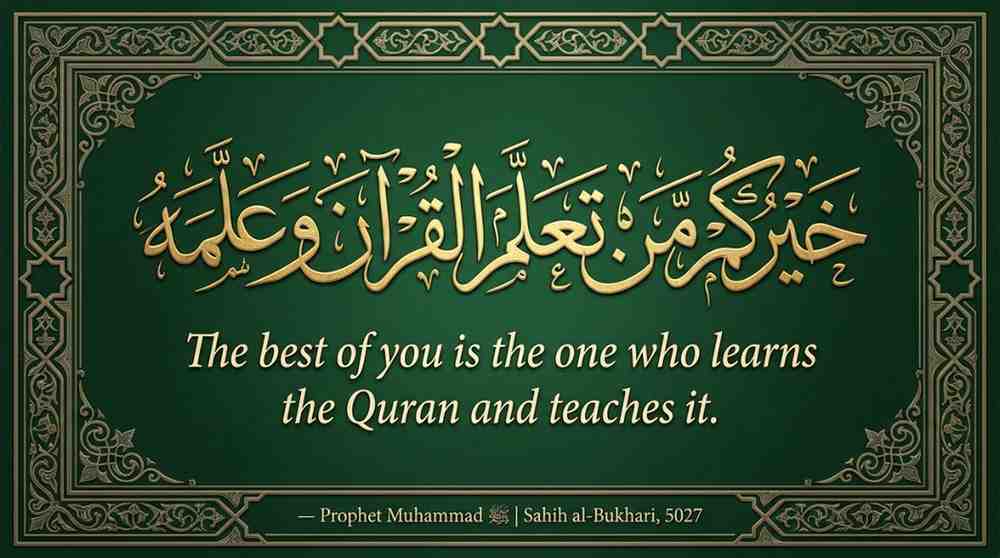
خَيْرُكُمْ مَنْ تَعَلَّمَ الْقُرْآنَ وَعَلَّمَهُ
“Khairukum man ta’allamal Qur’ana wa ‘allamahu”
“The best of you is the one who learns the Quran and teaches it.”
Narrated by Uthman ibn Affan (may Allah be pleased with him) · Sahih al-Bukhari, 5027
This is the most cited hadith in Islamic education, and its placement first is deliberate — the Prophet ﷺ used the word khairukum (“the best of you”), which is the highest comparative praise available in this context. Not “good among you” or “rewarded among you” — the best.
The hadith does two things simultaneously: it establishes learning the Quran as a mark of excellence, and it places teaching it at an equal or arguably higher level. The two are inseparable in the statement — learning alone, without passing it on, does not reach the fullness of what is being described. This is part of why the chain of transmission from teacher to student has been treated as sacred in Islamic scholarship: it is the living continuation of this hadith across generations.
Hadith 2: The Reward of Every Letter
مَنْ قَرَأَ حَرْفًا مِنْ كِتَابِ اللَّهِ فَلَهُ بِهِ حَسَنَةٌ وَالْحَسَنَةُ بِعَشْرِ أَمْثَالِهَا لَا أَقُولُ الم حَرْفٌ وَلَكِنْ أَلِفٌ حَرْفٌ وَلَامٌ حَرْفٌ وَمِيمٌ حَرْفٌ
“Man qara’a harfan min Kitabillahi falahu bihi hasanatun wal-hasanatu bi-‘ashri amthaliha, la aqoolu: Alif Lam Meem harfun, lakin alifun harfun wa lamun harfun wa meemun harfun.”
“Whoever recites one letter from the Book of Allah will receive one good deed, and the good deed is multiplied ten times. I do not say that Alif-Lam-Meem is one letter, but Alif is a letter, Lam is a letter, and Meem is a letter.”
Narrated by Abdullah ibn Mas’ud (may Allah be pleased with him) · Sunan al-Tirmidhi, 2910 (Hasan Sahih)
The Prophet ﷺ anticipated the question that would naturally arise — “does Alif-Lam-Meem count as one letter or three?” — and answered it directly within the hadith itself. The answer: three. Each individual letter carries its own multiplied reward, independently.
The practical implication of this hadith is significant for students who feel that reciting slowly, or reciting only a small amount, is somehow insufficient. The reward structure described is per letter — not per ayah, not per page, not per khatm. A student who recites ten lines carefully and correctly has produced an enormous quantity of good deeds by the arithmetic the Prophet ﷺ described, regardless of how few pages that represents.
Hadith 3: The One Who Struggles
الْمَاهِرُ بِالْقُرْآنِ مَعَ السَّفَرَةِ الْكِرَامِ الْبَرَرَةِ وَالَّذِي يَقْرَأُ الْقُرْآنَ وَيَتَتَعْتَعُ فِيهِ وَهُوَ عَلَيْهِ شَاقٌّ لَهُ أَجْرَانِ
“Al-mahiru bil-Qur’ani ma’as-safaratil-kirami-l-bararati, wal-ladhi yaqra-ul-Qur’ana wa yatata’ta’u fihi wa huwa ‘alaihi shaqqun lahu ajrani.”
“The one who is proficient in the Quran will be with the noble, righteous scribes (angels). And the one who recites the Quran and struggles with it, stammering or stumbling through its verses, will have a double reward.”
Narrated by Aisha (may Allah be pleased with her) · Sahih al-Bukhari, 4937 · Sahih Muslim, 798
This is perhaps the most comforting hadith for any beginning student, and its message is one that teachers return to constantly when students become discouraged. The Prophet ﷺ described two categories of Quran reciters — the proficient and the one who struggles — and awarded both categories with honor.
The proficient reciter is compared to the noble scribing angels — the highest company imaginable. The struggling reciter, the one who finds each letter an effort, receives a double reward: one for the recitation itself and one for the hardship of it. The hadith does not say “once you become proficient, you will be rewarded” — it says the struggling itself is rewarded, right now, in its difficulty.
For teachers, this hadith reframes what a student’s slow and effortful recitation actually represents — not a problem to be solved quickly, but an act of worship receiving its own elevated reward at every stumble.
Hadith 4: The Quran as Intercessor
اقْرَءُوا الْقُرْآنَ فَإِنَّهُ يَأْتِي يَوْمَ الْقِيَامَةِ شَفِيعًا لِأَصْحَابِهِ
“Iqra-ul-Qur’ana fa-innahu ya’ti yawmal-qiyamati shafi’an li-ashabihi.”
“Recite the Quran, for on the Day of Resurrection it will come as an intercessor for its companions.”
Narrated by Abu Umamah al-Bahili (may Allah be pleased with him) · Sahih Muslim, 804
The word ashabihi — “its companions” — is precise. It does not say “those who memorized it” or “those who recited it perfectly.” It says those who accompanied the Quran — who kept its company, who returned to it, who made it a consistent presence in their lives. Shafa’ah — intercession — in Islamic theology is the highest possible act of advocacy on the Day of Judgement, and the Prophet ﷺ attributed this role to the Quran itself, on behalf of anyone who maintained a relationship with it.
Hadith 5: The Companion of the Quran
“The Quran will meet its companion on the Day of Judgement when his grave is opened for him, in the form of a pale man, and will say to him: Do you recognise me? He will say: I do not recognise you. It will say: I am your companion the Quran, who kept you thirsty on hot days and kept you awake at night. Every merchant benefits from his trade, and today you are behind every trade. Then a kingdom will be placed in his right hand and eternity in his left, and the crown of dignity will be placed on his head, and his parents will be dressed in two garments that the people of the world could never afford.”
Narrated in Musnad Ahmad, 22344 · Ibn Majah, 3781
This longer narration from Musnad Ahmad gives the most vivid picture of the relationship between the Quran and the one who devoted themselves to it. The Quran identifies itself by what it cost its companion — thirst in the heat of fasting days spent in recitation, sleeplessness in the nights spent with it. The sacrifice is not incidental to the relationship — it is what the Quran describes as the proof of the companionship.
The mention of the parents being dressed — honoured through the child’s devotion to the Quran — is a particularly poignant detail that resonates with every parent who has invested years in their child’s Hifz or Quran education. The reward does not stop with the student.
Hadith 6: The Heart Without Quran
إِنَّ الَّذِي لَيْسَ فِي جَوْفِهِ شَيْءٌ مِنَ الْقُرْآنِ كَالْبَيْتِ الْخَرِبِ
“Innal-ladhi laysa fi jawfihi shay’un minal-Qur’ani kal-baytil-kharib.”
“Verily the one whose heart has nothing of the Quran in it is like a ruined house.”
Narrated by Ibn Abbas (may Allah be pleased with him) · Sunan al-Tirmidhi, 2913 (Hasan Sahih)
The Arabic word kharib — often translated as “ruined” — carries the specific image of a structure that has collapsed or been abandoned rather than a structure that was never built. The comparison is not to an empty field but to a house that once had the potential to be inhabited but has been left to deterioration. The implication is that every human heart has the capacity to hold the Quran — the “ruined” state is not the default, it is the result of absence.
This hadith is frequently cited by Islamic scholars to explain the emphasis placed on Quran education from early childhood: the heart’s architecture is best filled while it is still being formed, before other contents — distraction, negligence, heedlessness — occupy the space the Quran should inhabit.
Hadith 7: The Rank of the Hafiz
يُقَالُ لِصَاحِبِ الْقُرْآنِ اقْرَأْ وَارْتَقِ وَرَتِّلْ كَمَا كُنْتَ تُرَتِّلُ فِي الدُّنْيَا فَإِنَّ مَنْزِلَتَكَ عِنْدَ آخِرِ آيَةٍ تَقْرَأُهَا
“Yuqalu li-sahibil-Qur’ani: iqra’ wartaqi wa rattil kama kunta turatilu fid-dunya, fa-inna manzilataka ‘inda akhiri ayatin taqrauha.”
“It will be said to the companion of the Quran: Recite, and rise. Recite as you used to recite in the world, for your station will be at the last verse you recite.”
Narrated by Abu Sa’id al-Khudri · Sunan Abu Dawud, 1464 · Sunan al-Tirmidhi, 2914
This hadith describes the rank system in Jannah being tied directly to how much of the Quran a person memorized and recited in this life. The instruction to recite “as you used to recite in the world” — with the same tarteel, the same precision, the same care — means that how one recited in this life determines the pace of one’s ascent in the next.
The implication for Hifz students is profound: the effort to memorize and recite correctly is not merely a worldly religious practice — it is literally building one’s rank in the next life, verse by verse, recitation by recitation. The care taken over Tajweed, over correct waqf, over accurate memorization, is not perfectionistic attention to detail — it is the construction of a station whose height will be determined by the last verse of what was memorized.
What These Hadiths Mean for Students Today
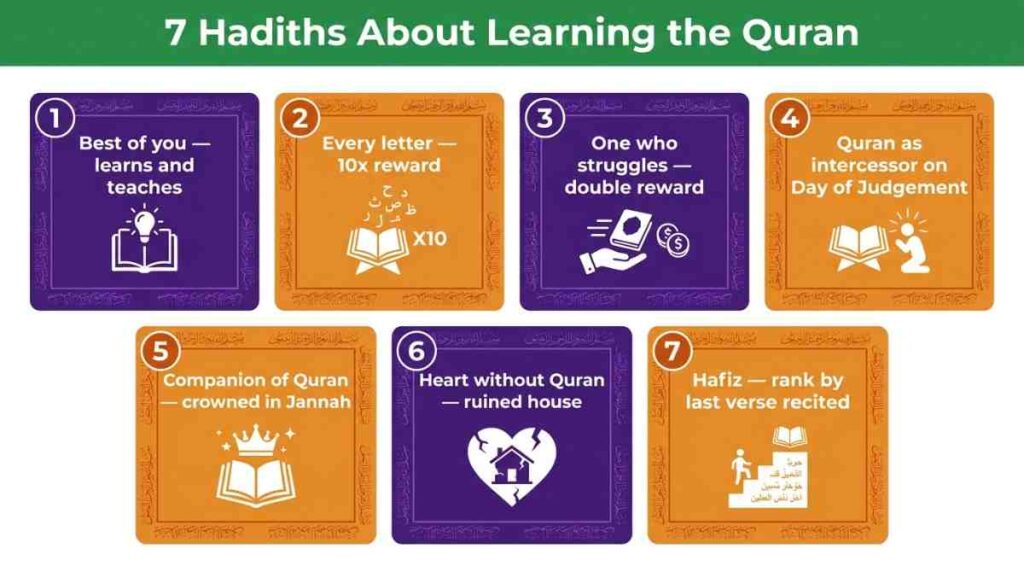
Read together, these seven hadiths paint a remarkably complete picture of the Prophet ﷺ’s view of Quranic learning — one that addresses students at every level and in every condition:
- The advanced reciter is honored with the angels (Hadith 3)
- The struggling beginner is doubly rewarded for their effort (Hadith 3)
- Every single letter carries multiplied reward, regardless of pace (Hadith 2)
- Learning and teaching are equally elevated — the chain must continue (Hadith 1)
- The Quran itself will advocate for its companions on the hardest day (Hadiths 4 and 5)
- The heart that holds the Quran is a inhabited house; the one without it is ruined (Hadith 6)
- The memorization built in this life determines one’s rank in the next (Hadith 7)
No level of Quran learning is too small to matter. No recitation is too imperfect to be rewarded. No age is too late to begin. These are not modern motivational statements — they are the specific, sourced words of the Prophet ﷺ, preserved across fourteen centuries, addressed to every person who opens the Mushaf today.
Begin Your Quran Journey — At Any Level, At Any Age
Book a free trial class at Suffah Quran Academy. Whether you are a complete beginner or returning to recitation after years away — there is a teacher here, and there is a reward for every letter.
Book Free Trial Class →Frequently Asked Questions
The most famous hadith is: “The best of you is the one who learns the Quran and teaches it.” (Sahih al-Bukhari, 5027). The Prophet ﷺ also said that the one who struggles with recitation receives a double reward, that every letter carries ten-fold reward, and that the Quran will intercede for its companions on the Day of Judgement.
Narrated by Uthman ibn Affan: the Prophet ﷺ said “Khairukum man ta’allamal Qur’ana wa ‘allamahu” — The best of you is the one who learns the Quran and teaches it. (Sahih al-Bukhari, 5027). Both learning and teaching are included in this highest praise.
The Prophet ﷺ said: “Whoever recites one letter from the Book of Allah will receive one good deed, and the good deed is multiplied ten times. I do not say Alif-Lam-Meem is one letter, but Alif is a letter, Lam is a letter, and Meem is a letter.” (Sunan al-Tirmidhi, 2910).
The Prophet ﷺ said: “The one who is proficient in the Quran will be with the noble, righteous scribes (angels), and the one who recites the Quran and struggles with it, stammering or stumbling through its verses, will have a double reward.” (Sahih al-Bukhari, 4937; Sahih Muslim, 798).
The Prophet ﷺ said: “Recite the Quran, for on the Day of Resurrection it will come as an intercessor for its companions.” (Sahih Muslim, 804). In another narration, the Quran meets its companion after death and identifies itself as the one that kept them thirsty on hot days and awake at night.
Yes. The Prophet ﷺ said: “The one whose heart has nothing of the Quran in it is like a ruined house.” (Sunan al-Tirmidhi, 2913). The image of a ruined — rather than simply empty — house suggests the heart has the capacity to be inhabited but has been left to deterioration.
The Prophet ﷺ instructed parents to teach their children prayer and Quran, and established that a teacher of the Quran receives reward for every letter their student recites — without the student’s own reward being diminished. The transmission of Quran from teacher to student is itself an act of ongoing sadaqah jariyah.
Final Thoughts
The Prophet ﷺ left behind no ambiguity about the place of the Quran in a Muslim’s life. From the reward of every single letter to the intercession on the Day of Judgement, from the honor given to the struggling beginner to the rank awarded to the Hafiz — every stage of the Quran journey, from first letter to complete memorization, is addressed, honored, and rewarded.
These hadiths are the reason Quranic education has been the first and most sustained investment of Muslim families across every generation and every continent. They remain the reason it matters today.
Every Letter. Every Recitation. Every Level.
Book a free trial class at Suffah Quran Academy — and let your journey with the Quran begin where you are.
Claim Your Free Trial →
Written by Ustaz Abdul Hannan
Arabic & Islamic Studies Teacher · 7 Years Experience · Arabic, Duas, Islamic Studies
Ustaz Abdul Hannan teaches Arabic grammar, Duas, and Islamic studies with a focus on helping students understand the meaning behind what they recite. He returns to these seven hadiths at the beginning of every new student’s journey — because understanding why the Quran matters, from the words of the Prophet ﷺ himself, changes how a student approaches every session after.
Meet our teaching team →