This post contains affiliate links.
Published: Junly 02, 2026 · ⏱ 8 min read · Ustaz Imran Qadri, Tajweed Expert
Open any Mushaf and you’ll see small marks scattered above the Arabic text — some look like a single letter, others like dots or tiny words. These are waqf symbols, and most students recognize them long before anyone explains what each one is actually telling them to do.
This article is a focused, symbol-by-symbol breakdown — what each mark looks like, what it means, and a real example of where you’ll encounter it in the Quran. If you want the broader rules around stopping and pausing duration, our complete guide to waqf rules and rules of stopping explained cover that in depth. This one is just about the symbols themselves.
Why You Need to Recognize These by Sight
Tajweed teachers don’t expect students to stop and “think” about a waqf symbol mid-recitation — by the time a student is reading fluently, recognizing the symbol and reacting correctly needs to happen instantly, the same way a driver reacts to a stop sign without consciously reading the word “STOP” every time.
That only happens with repeated exposure and correction. Below is every symbol broken down individually, in the order students typically encounter them.
ۘ — Waqf Lazim (Compulsory Stop)
What it looks like: A small mark resembling the Arabic letter “م” with a flourish, placed above the line.
What it means: You are required to stop here. The ayah’s meaning is structured in a way that continuing without pausing creates confusion or a misleading reading.
Why it’s rare: Because it’s a strict requirement, scholars only marked it where stopping is genuinely necessary — not as a general suggestion. Students often forget it exists simply because they encounter it so infrequently.
لا — Waqf Mamnoo’ (Forbidden Stop)
What it looks like: The Arabic word “لا” (meaning “no”) placed above the text.
What it means: Do not stop here, even if you need to breathe. If breath becomes necessary, go back a few words to a permitted stopping point and resume from there, rather than pausing exactly where the breath ran short.
Common mistake: Treating this like any other stop when tired or rushing. This is the single most important symbol to internalize, because ignoring it is the easiest way to accidentally change meaning.
ج — Waqf Jaiz (Permissible Stop)
What it looks like: The Arabic letter “ج” alone, standing for “jaiz” (permissible).
What it means: You may stop or continue — both are valid, and the meaning of the ayah holds up either way. This is the most frequently occurring symbol in the Quran.
Common mistake: Assuming “permissible” means “preferred.” It doesn’t — it’s neutral. Plenty of fluent reciters read straight through a Jaiz mark without pausing at all.
قلى — Qila Alayhil Waqf (Preferable to Stop)
What it looks like: The Arabic letters forming “قلى,” a slightly longer mark than Jaiz.
What it means: Stopping here is the better choice, though continuing isn’t incorrect. Think of this as the symbol nudging you gently toward pausing without making it mandatory.
Where it shows up: Often at points where the ayah shifts topic or tone slightly, even though grammatically the sentence could technically continue.
صلى — Sila (Preferable to Continue)
What it looks like: The Arabic letters forming “صلى,” visually similar in style to Qila Alayhil Waqf but with the opposite instruction.
What it means: Continuing is the better choice here, though a pause is technically allowed if a breath is genuinely needed.
How to tell it apart from Qila Alayhil Waqf: Students frequently confuse these two because they look similar at a glance. The clearest way to remember the difference: Sila sounds like “silsila” (continuation/chain) — a small memory hook that helps differentiate it from Qila.
∴ ∴ — Mu’anaqah (Either/Or Stop)
What it looks like: Two sets of three dots, positioned a few words apart from each other within the same area of text.
What it means: Stop at one of the two points — never both, and never neither. The two sets of dots represent two valid stopping options, but the reciter is meant to choose exactly one each time through.
Why it confuses students: It’s visually unlike every other waqf symbol, so students often don’t recognize it as a waqf mark at all the first few times they see it, and either skip past both points or pause at both by mistake.
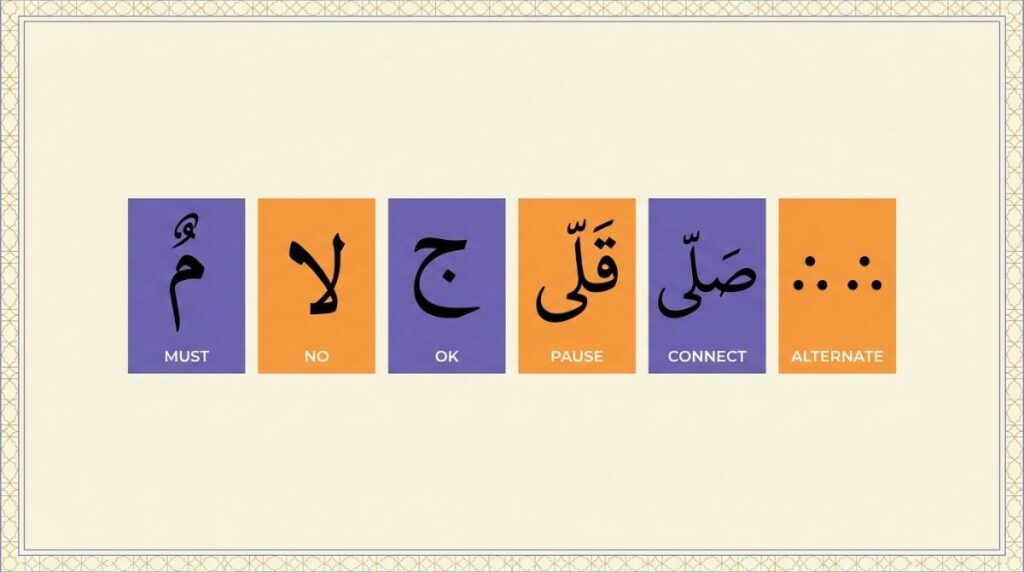
Quick Visual Comparison
| Symbol | Looks Like | Action | Memory Hook |
|---|---|---|---|
| ۘ | Flourished “م” mark | Must stop | Rare = serious |
| لا | The word “no” | Never stop | “لا” = “No” stopping |
| ج | Single letter “ج” | Optional | Jaiz = just your choice |
| قلى | Short word mark | Lean toward stopping | Slight pause nudge |
| صلى | Short word mark | Lean toward continuing | Sounds like “silsila” (chain) |
| ∴ ∴ | Two sets of 3 dots | Pick one, not both | Either/or pair |
A Note on Different Mushaf Editions
Not every printed Mushaf marks waqf symbols identically — some regional printings use slightly different conventions or include marks that others omit. The Madani Mushaf (the standard most students learn from) is consistent and widely used, which is part of why we recommend students train on the same edition consistently rather than switching between apps or print copies with different marking systems.
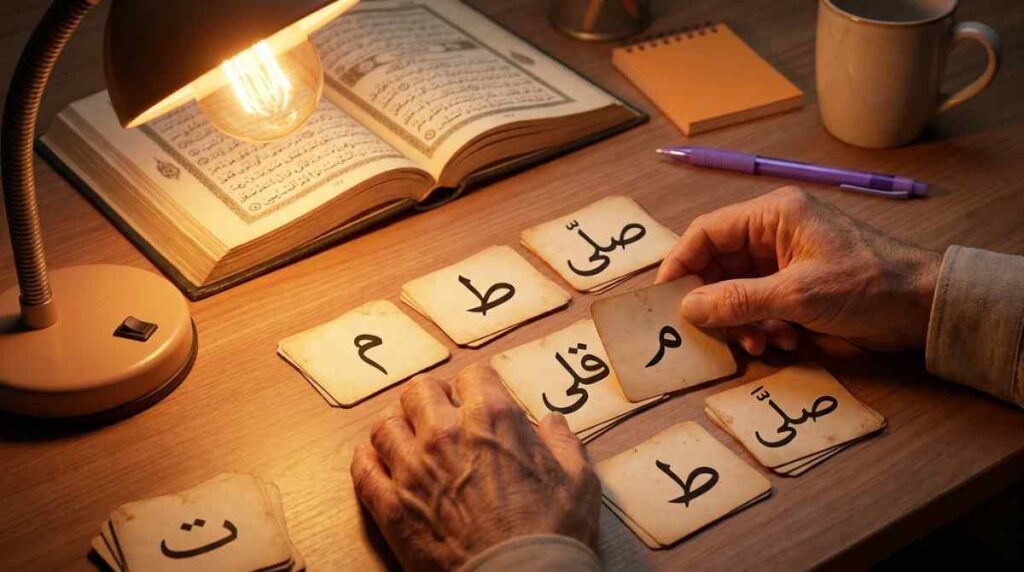
How to Build Symbol Recognition Without Memorizing in Isolation
Flashcards and symbol charts help with initial recognition, but the skill that actually matters is recognizing the symbol mid-flow, while your eyes are already moving through Arabic text. The way we build this with students:
- Start with short, familiar surahs the student already knows well, and have them point out every waqf symbol before reading.
- Move to unfamiliar text and time how quickly the student can identify each symbol on first read.
- Layer in actual recitation, where the teacher corrects in real time whenever a symbol is misread or ignored.
This progression matters because recognizing a symbol on a flashcard and recognizing it embedded in flowing Arabic text are genuinely different skills — and only the second one is useful during real recitation.
Struggling to Recognize Waqf Symbols While Reading?
Join a free trial class and practice with live correction from a Tajweed teacher.
Book Free Trial Class →Frequently Asked Questions
Mu’anaqah appears as two sets of three dots placed a few words apart. It signals that the reciter should stop at exactly one of the two points, never both and never neither.
Qila Alayhil Waqf (قلى) means stopping is the better choice, though continuing isn’t wrong. Sila (صلى) means continuing is the better choice, though a pause is allowed if needed. Memory hook: Sila sounds like “silsila” (chain/continuation).
Not always. Some regional printings use slightly different conventions. The Madani Mushaf is the standard most students learn from, and training consistently on one edition is recommended.
Flashcards help with initial recognition, but the real skill is recognizing the symbol mid-flow while reading actual Arabic text. Start with familiar surahs, move to unfamiliar text, then practice with live teacher correction during real recitation.
Final Thoughts
Six symbols, six instructions — once they’re memorized cold and drilled into actual recitation, waqf stops being a guessing game. The marks aren’t decoration; each one exists because scholars identified a specific, recurring point of confusion in the text and built a system to prevent it.
For the full rules around how long each stop should last and where incorrect stopping changes meaning, see our rules of stopping guide. If you’re still working on pronunciation fundamentals, start with Tajweed rules for beginners before layering in waqf.
Ready to Recite With Confidence?
Start with a free trial class — no commitment, just honest feedback.
Claim Your Free Trial →
Written by Ustaz Imran Qadri
Tajweed Expert · 9 Years Experience · Tajweed Rules, Makharij
Ustaz Imran Qadri has spent nine years correcting recitation one-on-one, with a focus on Tajweed rules and precise articulation points (makharij). He believes most recitation mistakes trace back to rushed fundamentals rather than lack of effort.
Meet our teaching team →