

This post contains affiliate links.
Published: June 25, 2026 · ⏱ 8 min read · Ustaz Hamza Siddiqui, Hifz Support Teacher
The Hifz teacher does their part in the class. They introduce new Sabaq, correct errors, manage Sabqi and Manzil, and guide the student through the journey. What happens in class matters enormously.
But the class is 1-2 hours. The rest of the day — 22 hours — is the family’s. And it is in those 22 hours that Hifz either holds or fades.
This guide gives parents a clear, practical framework for those 22 hours. None of it requires knowledge of the Quran. All of it makes a measurable difference.
The 22 Hours That Determine Hifz Outcomes
In our guide on the Sabaq-Sabqi-Manzil system, we explain how memorisation works through three daily components: new Sabaq, recent Sabqi revision, and long-term Manzil revision. The teacher manages Sabaq and Sabqi in the class. The Manzil — and the preparation of the next day’s Sabaq at home — depends on the family.
A student who receives excellent teaching in class but does zero home revision will lose a significant portion of each day’s Sabaq before the next session. A student with the same teacher who also completes daily Manzil revision and prepares Sabaq at home will make dramatically faster progress — and build memorisation that holds over years.
The teacher cannot control what happens at home. Only the family can. This guide exists because what the family does in those 22 hours is not instinctive — it needs to be learned, like any other parenting skill.
The Most Important Thing: Daily Listening
If there is only one thing a parent does to support their child’s Hifz at home, it should be this: sit with your child daily while they recite from memory, following along in an open Mushaf.
You do not need to know the Quran. You need to be able to follow the text with your eyes while your child recites. When your child looks at the Mushaf — when they are supposed to be reciting from memory — you note it. When they stumble or skip words, you see it and note it for the teacher.
This listening serves three functions simultaneously:
- Accountability. A child who knows a parent will be listening practises their Sabaq and Manzil more carefully than one who revises alone. The anticipation of being heard changes the preparation.
- Retention. Reciting to a listener — even a silent, attentive one — strengthens memory more than silent private repetition. The slight pressure of performance consolidates the memory in a different way.
- Error detection. Even a parent who cannot identify Tajweed errors can see when a child is looking at the page during a memory recitation, hesitating frequently, or skipping sections. That information, passed to the teacher, is valuable.
Practical daily structure:
| Activity | Who Leads | Time | Parent’s Role |
|---|---|---|---|
| Sabaq preparation (new material) | Child reads from Mushaf independently | 15–20 min | Available nearby; check in at end |
| Manzil recitation | Child recites from memory | 15–30 min | Follow in open Mushaf, note hesitations |
| Sabqi review (recent portions) | Child recites from memory | 5–10 min | Follow in Mushaf, confirm solidity |
Total parent time: approximately 20-35 minutes of attentive listening per day. This is the most impactful Hifz investment a parent makes — more than any book, app, or supplementary resource.
Protecting the Hifz Schedule
Hifz requires daily consistency — and daily consistency requires a protected time slot in the family’s routine. The Hifz session, both the class and the home revision, should be treated as non-negotiable.
This is easier said than done. As children grow older, competing demands multiply — school activities, sports, social events, extracurricular classes. The family’s job is to ensure that these compete with each other for the remaining slots in the schedule, not with Hifz. Hifz is the anchor.
Practical approaches:
- Attach Hifz to a fixed daily time anchor — after Fajr, before school, after school, after Maghrib. A time that is already in the routine is harder to displace than one that floats.
- Treat the class as non-negotiable — the same way school is non-negotiable. Missing a class requires a reason, not just a preference.
- Communicate the schedule to extended family. Grandparent visits, family events, and school holidays all have a way of disrupting Hifz routines. Setting the expectation with extended family — “this time is Hifz time” — reduces friction when conflicts arise.
- Plan around predictable disruptions. School exams, Ramadan schedule changes, holidays — these are predictable. Talk to the teacher in advance to agree a maintenance routine for disruption periods, so returns to full practice are smoother.
Creating the Right Home Environment

The home environment shapes a child’s relationship with the Quran more than any scheduled session. A home where the Quran is present — heard, recited, referenced, valued — produces a different Hifz student from a home where the Quran is only encountered during scheduled class time.
Specific environmental practices:
- Play Quran recitation regularly. Background recitation during breakfast, car journeys, or before sleep builds passive familiarity with the text. A child who has heard their current Surah played many times begins active memorisation with an existing familiarity that significantly reduces the number of repetitions needed.
- Recite together. Short Surahs recited together before sleep, Bismillah and Alhamdulillah in daily conversation, Al-Fatiha recited as a family at the start of something meaningful — these practices normalise Quran as part of the texture of family life.
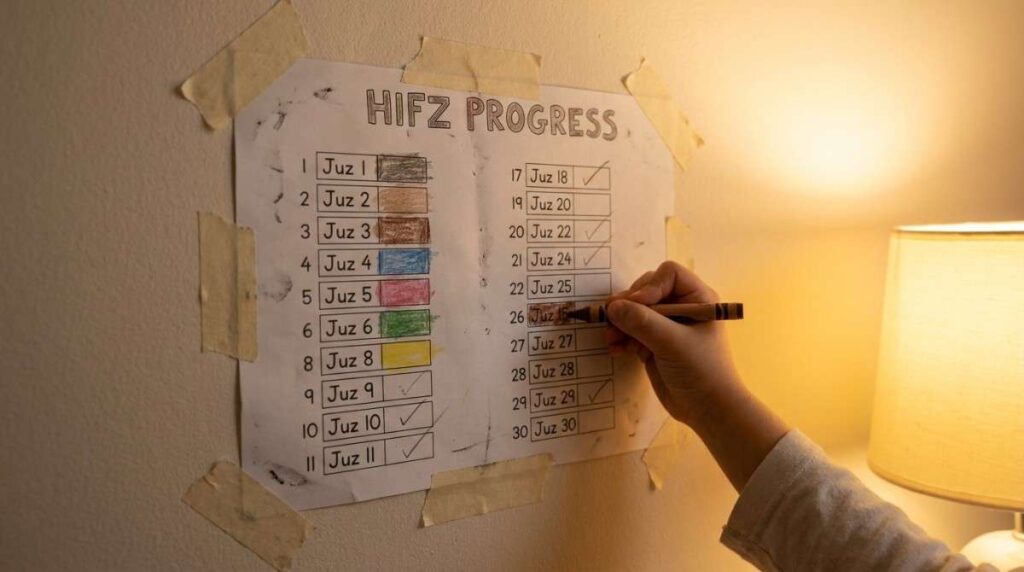
- Make progress visible. A chart on the bedroom wall showing completed Juz, coloured in as they are consolidated, gives a child a concrete visual of what they have achieved. The pride in a filling chart is a genuine motivational force across years.
- Speak about Hifz with reverence. The way parents talk about their child’s Hifz in the child’s presence shapes how the child relates to it. “Your Quran” — the Quran your child is memorising — should be spoken about with genuine reverence and pride, not framed as a burden or an obligation to be discharged.
Staying Connected With the Teacher
The Hifz teacher is the expert in your child’s memorisation journey. Parents who stay in active communication with the teacher make better-informed home support decisions — and the teacher benefits from knowing what is happening at home.
Useful communication patterns:
- After each session: Ask what the child should revise at home before the next class. Specific is better than general — “revise the Sabaq from today and the Manzil section 3” is more useful than “keep practising.”
- Weekly check-in: A brief message or note asking “how is the pace, what should we focus on this week?” keeps the parent informed without becoming an intrusion into the teaching relationship.
- When something is off at home: If a child has had a particularly difficult week — illness, family stress, school pressure — let the teacher know. A teacher who knows a student is struggling outside Hifz can adjust the session accordingly rather than pushing on a day when the child has nothing to give.
- When errors keep returning: If your listening reveals the same error appearing repeatedly in the Manzil, report it specifically to the teacher. “He keeps skipping the third verse of the second Ruku in Surah Al-Kahf” is correctable. “He sometimes makes mistakes” is not actionable.
Emotional Support Through the Hard Stretches
Every Hifz journey has hard stretches — the middle Juz that will not stick, the month where everything feels like forgetting, the days where the child actively resists sitting down. Parents who navigate these stretches well produce children who continue. Parents who respond with pressure, shame, or comparison often produce children who eventually stop.
What helps during hard stretches:
- Reduce the target, not the habit. On difficult days, do 10 minutes of Manzil instead of 30. The habit of sitting down and doing something is preserved even when the volume shrinks. Never let a difficult stretch become a gap — gaps are significantly harder to recover from than maintained-but-reduced practice.
- Separate the child from the difficulty. “This Surah is hard” is true and acceptable. “You are bad at this” is neither true nor acceptable. The difficulty belongs to the material, the stage, the day — not to the child’s character or capacity.
- Reconnect to why. In low-motivation stretches, gentle reminders of the Islamic reasons for Hifz — not as pressure, but as orientation — help a child (and a parent) remember what the difficulty is in service of.
- Mark and celebrate milestones. Completing a Juz, completing a quarter of the Quran, completing the first half — these are genuine milestones that deserve genuine celebration. Not a lecture about how much is left. A real acknowledgement of what has been achieved.
What Not to Do
These are the most common parental mistakes in supporting Hifz at home — not from bad intentions, but from misunderstanding what actually helps:
Correcting the teacher’s corrections. If the teacher has corrected a word or pronunciation and the parent believes they know better — trust the teacher. Unless you hold an Ijazah and can demonstrate a specific error in the teacher’s instruction, accept the teacher’s correction as authoritative. Children who receive conflicting corrections from parent and teacher do not know whose version to memorise.
Comparing to siblings or other children. “Your cousin finished three Juz already” achieves nothing except shame. Each child’s pace is their own. Comparison — particularly in Hifz, which is a personal spiritual journey — creates anxiety rather than motivation.
Using Hifz as punishment. “If you misbehave, extra Hifz time” creates an immediate negative association. Hifz time must remain a positive, even if challenging, space. Once it becomes punishment, rebuilding the relationship between the child and their Hifz is very difficult.
Expecting perfection. Hifz involves forgetting. A child who cannot recite a portion they learned two weeks ago is not failing — they are experiencing the normal forgetting curve that the Sabqi and Manzil system exists to address. Responding to normal forgetting with frustration damages the child’s willingness to attempt recitation.
Work With a Teacher Who Keeps You Informed
At Suffah Quran Academy, our Hifz teachers provide regular parent updates — what was covered, what to revise at home, how the child is progressing. You are never in the dark about your child’s journey.
Frequently Asked Questions
The most impactful things: listen to daily Sabaq and Manzil recitation (following in the Mushaf), protect the daily Hifz time from competing activities, play Quran recitation regularly in the home, communicate with the teacher about what to focus on, and maintain positive emotional associations with Hifz by avoiding pressure and comparison.
No. The most important role — listening to daily recitation — requires only following in an open Mushaf while the child recites from memory, and noting when they look at the page when they should not. You do not need Tajweed knowledge. Your presence and attention are what matter most.
Approximately 20-35 minutes of attentive daily listening covers the Manzil and Sabqi revision a child needs to do at home. Environmental support — playing Quran recitation, positive conversations, protecting the schedule — requires no additional scheduled time. The daily listening session is the highest-impact investment.
Reduce the length, not the habit — 10 minutes beats zero. Avoid power struggles that make Hifz the battleground. Maintain the routine even when the attitude is reluctant. Communicate with the teacher if resistance is persistent — they can often identify the cause and adjust the approach.
Ask the teacher directly after each session — what should my child practise at home before the next class? A good Hifz teacher will specify the Sabaq to repeat, the Sabqi portions to revise, and the current Manzil section for the day. This makes home practice targeted rather than vague.
The Teacher and the Family — Two Halves of One Journey
The Hifz teacher and the family are not in competition. They are partners in the same journey — each doing what the other cannot.
The teacher provides qualified instruction, immediate correction, structured progression, and a professional relationship with the material. The family provides daily listening, schedule protection, emotional support, and the home environment where the Quran either lives or does not.
The families whose children complete Hifz are not those who left everything to the teacher. They are those who understood their own role — and played it consistently, year after year, through the hard stretches and the milestones alike.
Begin the Hifz Journey With a Partner Who Supports You Too
Our Hifz teachers work with parents — not around them. Regular updates, clear home revision instructions, and honest communication throughout the journey. Book a free assessment to meet the teacher.

Written by Ustaz Hamza Siddiqui
Hifz Support Teacher · 5 Years Experience · Hifz Support, Revision · Urdu, Hindi
Ustaz Hamza Siddiqui has spent 5 years working with Hifz students and their families — and has seen directly how the home environment shapes outcomes. The families whose children complete Hifz almost always have one thing in common: a parent who shows up daily for the listening session, protects the schedule, and stays connected with the teacher throughout the journey.