This post contains affiliate links.
Published: June 23, 2026 · ⏱ 7 min read · Ustadah Noor Fatima, Beginner Quran Teacher
You grew up in a Muslim family. You prayed — or tried to. You attended Eid prayers and heard the Quran recited around you your whole life. But somewhere along the way, you never learned to read it. Not properly. And now you are an adult, and the gap feels too large and the embarrassment too heavy to do anything about it.
This article is written directly for you.
You Are Not Alone
The number of Muslim adults in the UK, USA, Canada, and Australia who cannot read the Quran — or who can recite a few memorised Surahs but cannot actually read Arabic text — is larger than most people would guess. Studies and community surveys consistently show that a significant proportion of Western-raised Muslims fall into this category.
The reasons are varied. Families moved and Islamic schooling was not available. Mosque classes were difficult or unwelcoming. Learning attempts were interrupted. Life happened.
Whatever the reason, the result is the same: an adult Muslim who wants to connect with the Quran but does not know how to begin. If that is you, you are not uniquely failing. You are in a situation that many Muslims share — and that has a clear, practical solution.
There Is No Shame in Beginning
“The one who recites the Quran but falters in it — and it is difficult for him — will have two rewards.”
— Prophet Muhammad ﷺ | Sahih Muslim, Hadith 798
The Hadith the Prophet ﷺ gave us about struggling reciters is one of the most generous in all of Islamic teaching. He did not say “the one who struggles should wait until they are ready.” He praised the struggle itself — and placed the struggling reciter alongside the fluent one, giving them double the reward.
The shame many adults carry about not knowing the Quran is understandable — but it is misplaced. The shame belongs to years of not beginning. The honour belongs to the day of beginning, at whatever age that happens to be.
Every teacher at Suffah Quran Academy who works with adult beginners says the same thing: the adult who arrives at their first class having never read a word of Arabic is doing something genuinely courageous. The willingness to be a beginner — at 30, at 45, at 60 — is not weakness. It is one of the most admirable things a person can do.
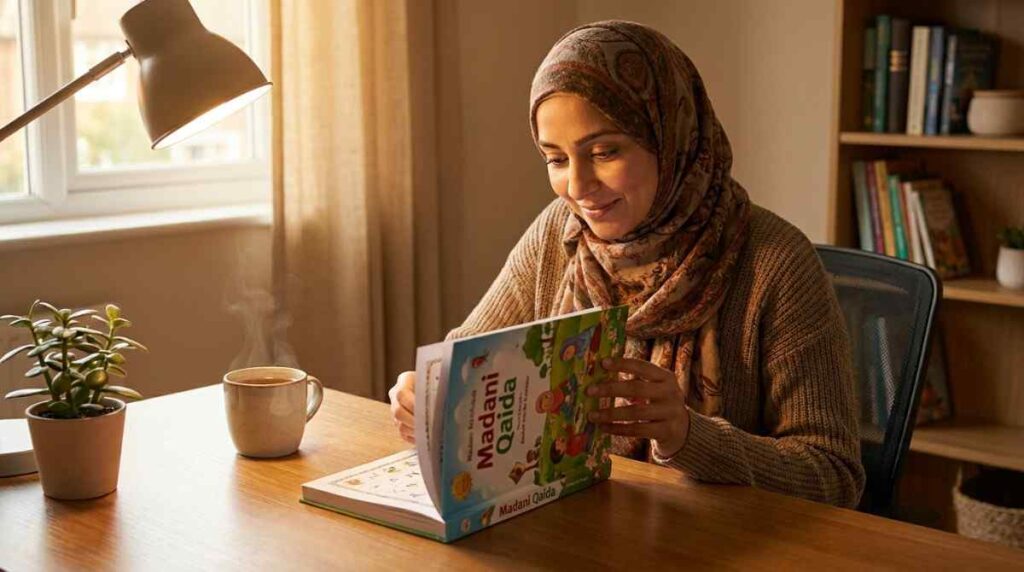
Exactly Where to Start — Madani Qaida
The starting point is the same regardless of age, regardless of how much you already know, regardless of how long you have been Muslim: Madani Qaida.
Madani Qaida is a structured beginner’s programme designed to take a student from zero — no Arabic knowledge whatsoever — to reading connected Quranic text. It has been used for decades across the Muslim world and remains the most effective starting point for complete beginners at any age.
What Madani Qaida covers:
- Arabic letter recognition: All 29 letters — their shapes, their names, and their sounds
- Letter forms: How each letter looks at the beginning, middle, and end of a word
- Vowel marks (Harakat): The small marks above and below letters that determine vowel sounds — Fathah, Kasrah, Dhammah, Sukoon, Shaddah, Madd
- Connected reading: Reading letters joined together as words
- Basic Tajweed: The foundational pronunciation rules applied from the beginning — not as advanced theory but as practical guidance for reading correctly
By the end of Madani Qaida, you can read any Arabic text that has vowel marks — including the Quran. You may be slow. Some letters may still need work. But you can read.
For a full explanation of what Madani Qaida teaches, see our guide: What Is Madani Qaida?
What to Expect: Stage by Stage
Stage 1: Letter recognition (first 4-6 weeks)
Your first several sessions will focus on Arabic letters — their shapes and their sounds. You will learn to recognise each letter and produce its sound. This stage feels like a lot of memorisation, but most adults find that the letters come faster than they expected, particularly once the vowel sounds are introduced and letters start to make words.
Stage 2: Vowel marks (weeks 4-10)
Once the letters are established, you add the vowel marks. This is where reading starts to feel real — you can look at a marked Arabic word and sound it out. The connection between what you are reading and what you have heard in the Quran your whole life begins to form. Many adults describe this as a powerful moment: hearing familiar words from Salah and recognising them on the page for the first time.
Stage 3: Connected reading and basic Tajweed (months 2-5)
Letters joined together. Words. Short phrases. Basic Tajweed rules introduced as you encounter them — not as abstract theory but as practical pronunciation guidance. By the end of this stage, you are reading short Quranic phrases from the Qaida and beginning to transition to reading directly from a Quran.
Stage 4: Quran reading (months 4-14 from start)
After completing Madani Qaida, you begin reading from the Quran itself — typically starting from Juz Amma (the 30th chapter, containing the shorter, more familiar Surahs) and progressing through the Quran as fluency develops. A qualified teacher continues to correct Tajweed errors and deepen the quality of your reading throughout this stage.
How Long It Takes
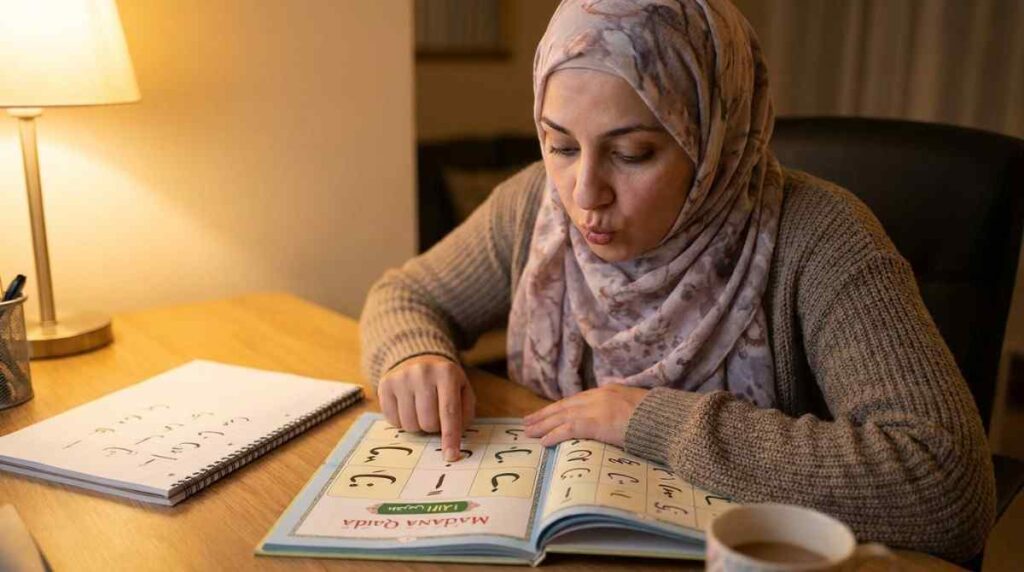
From zero Arabic knowledge to reading Quran fluently, most adults attending 2-3 sessions per week with daily home practice take 8-14 months.
This includes:
- Madani Qaida completion: 3-5 months
- Quran reading to fluency: 5-9 additional months
These timelines assume consistent attendance and 10-15 minutes of daily home practice. Without daily practice, the timeline extends. With 3 sessions per week instead of 2, it compresses.
For a detailed breakdown by age and programme frequency, see our guide on how long it takes to learn to read the Quran.
What to Do in Salah While You Are Still Learning
Many adult beginners worry about this: “I cannot read Arabic — how do I pray correctly while I am learning?”
The answer is straightforward: pray with what you know. A Salah that contains Al-Fatiha recited from memory and one or two short Surahs you know is a valid, complete prayer. You do not need to be able to read new Surahs before you can pray.
As your reading develops, your Salah naturally enriches. New Surahs you learn in class get added to your Salah recitation — each one a direct practical application of what you are learning. Within a few months of beginning, your Salah will contain more Quran than it ever has before. That is one of the most tangible early rewards of beginning.
If you are currently not praying regularly because you feel you cannot do it correctly — begin praying with what you have, and learn alongside. The two are not in conflict. They strengthen each other.
Choosing the Right Teacher for a Beginner
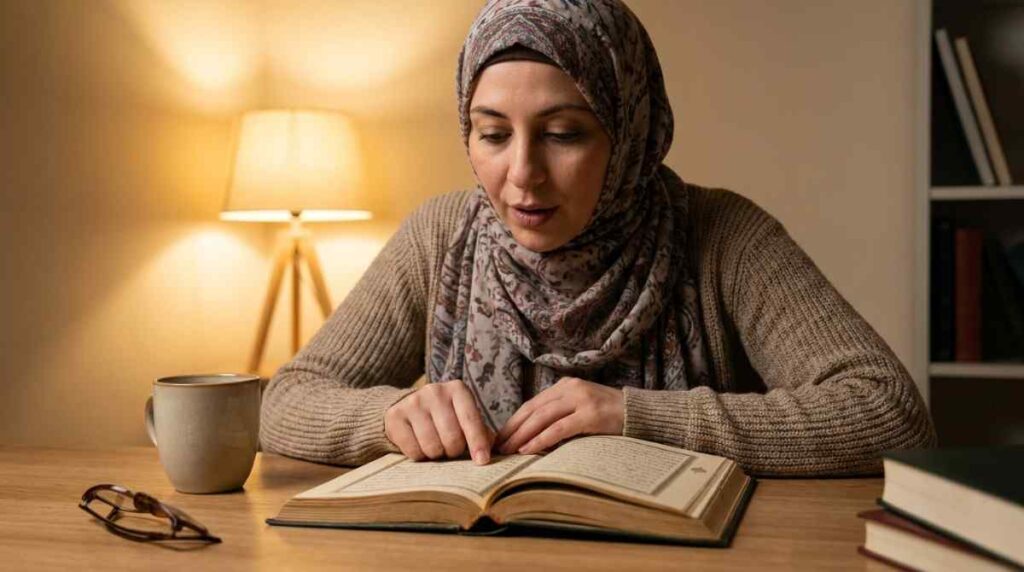
For adult beginners, the teacher’s manner is as important as their qualification. You need:
- Patience. An adult beginner learning Arabic letters for the first time needs more repetitions than a child, more explanation, and more patience when progress feels slow. A teacher who shows frustration at a beginner’s pace is the wrong teacher for you.
- No judgment. You are an adult who never learned something you feel you should have learned earlier. The right teacher understands this and creates a space where beginning feels honourable, not embarrassing.
- Qualification. Patience and warmth without Ijazah certification means a teacher who cannot guarantee the accuracy of what they are teaching. You need both — patience and verified credentials.
- One-on-one format. Adult beginners particularly benefit from individual instruction. The pace can be set by your capacity, the explanations can match your learning style, and the teacher can give you their full attention without managing other students.
At Suffah Quran Academy, our beginner teachers — including Ustadah Noor Fatima — specialise in working with adult beginners. The combination of Ijazah certification, patience, and a genuinely judgment-free approach is what makes the beginning sustainable rather than discouraging.
Begin Today — The First Class Is Free
No Arabic knowledge required. No judgment. A qualified teacher who specialises in complete beginners. One free session to start — no payment, no commitment.
Frequently Asked Questions
Start with Madani Qaida — a structured beginner’s programme that takes you from zero knowledge of Arabic letters to reading connected Quranic text. No prior knowledge required. Most adults complete it in 3-5 months with 2-3 sessions per week. After completion you move directly to reading from the Quran.
The embarrassment many feel is understandable but misplaced. Every Muslim who begins learning Quran — at any age — is doing something honourable. The Prophet ﷺ said the one who struggles with Quran recitation receives double the reward. Beginning is the courageous act. The reward belongs to the effort that starts today.
Yes — completely. Madani Qaida begins from the very first Arabic letter. You need no prior Arabic knowledge. Adults with zero prior knowledge routinely complete Madani Qaida and progress to fluent Quran reading. The only requirements are willingness and consistent attendance.
From zero to reading Quran fluently typically takes 8-14 months for adults attending 2-3 sessions per week with daily home practice. This includes completing Madani Qaida (3-5 months) and Quran reading with basic Tajweed (5-9 months). Consistent attendance and 10-15 minutes of daily revision are the key factors.
Pray with what you already know from memory — Al-Fatiha and any Surahs you have memorised are sufficient for valid Salah. Do not delay prayer waiting for perfect Arabic reading. As your reading develops, your Salah naturally enriches. The two practices strengthen each other.
The Only Step That Matters Is the First One
Everything in this guide — the stages, the timelines, the teacher characteristics — follows from one single act: beginning.
You cannot know what it feels like to read Al-Fatiha from the page rather than from memory until you learn. You cannot know what it feels like to open the Quran and understand that you are reading the words of Allah, correctly, from the text — until you have done the work that makes it possible.
That work begins with a first session. One session, with a qualified teacher, where no one judges how little you know and everyone respects how much it took to show up.
The Prophet ﷺ said the struggling reciter has two rewards. The adult who begins today — at whatever level, from wherever they are — is earning the reward that goes with the struggle. Not despite starting late. Regardless of it.
Start Here — No Arabic Knowledge Required
Ustadah Noor Fatima specialises in teaching complete beginners — adults who have never read Arabic before. Patient, qualified, judgment-free. Your first session is free.

Written by Ustadah Noor Fatima
Beginner Quran Teacher · 3 Years Experience · Beginner Quran Reading, Qaida · Urdu, Hindi
Ustadah Noor Fatima teaches beginners with patience and care — specialising in children and adults starting their Quran journey for the very first time. She understands the particular courage it takes to begin as an adult, and creates a learning environment where that courage is honoured and the beginning is made as gentle and effective as possible.