
This post contains affiliate links.
Published: June 06, 2026 · ⏱ 8 min read · Ustaz Ahmad Raza, Senior Quran & Tajweed Teacher
This is the question almost every new student asks — and the honest answer is: it depends. But “it depends” without any specifics is not useful. So here are the specifics.
This guide gives realistic timelines — not the fastest possible case, not a deliberately discouraging worst case, but what actually happens for most students who attend consistently with a qualified teacher.
What “Learning to Read” Actually Means
Before timelines, a definition matters. “Learning to read the Quran” can mean several different things depending on who is asking:
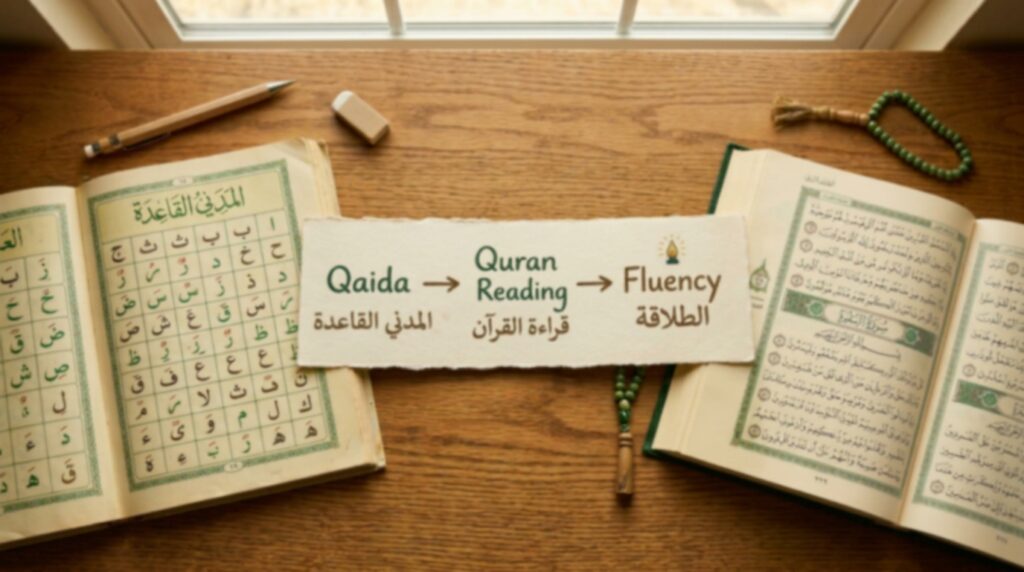
- Recognising Arabic letters: The very first stage — knowing the shapes and names of all 29 letters. This is Stage 1 of Madani Qaida.
- Reading Arabic with vowel marks: Being able to sound out any Arabic word that has harakat (vowel marks). This is the end of Madani Qaida.
- Reading Quran text fluently: Reading actual Quranic text at a reasonable pace, applying basic Tajweed, without significant hesitation. This is after completing Madani Qaida and working through Quran reading lessons.
- Reading with full Tajweed: Applying all Tajweed rules consistently throughout recitation. This is a more advanced stage that develops over years.
Most people asking this question want to reach the third stage — fluent Quran reading. That is what the timelines below address.
Timeline for Children
| Age | Classes/Week | Madani Qaida | Fluent Quran Reading | Total |
|---|---|---|---|---|
| 4–5 years | 2 per week | 9–12 months | 12–18 months | 21–30 months |
| 5–7 years | 3 per week | 6–9 months | 8–12 months | 14–21 months |
| 7–10 years | 3 per week | 4–6 months | 6–10 months | 10–16 months |
| 10–13 years | 3 per week | 3–5 months | 5–8 months | 8–13 months |
These timelines assume consistent attendance, a qualified one-on-one teacher, and 10–15 minutes of home practice daily. Without home practice, add approximately 30–50% to the estimates.
Timeline for Adults
| Starting Point | Classes/Week | Stage 1: Qaida | Stage 2: Quran Reading | Total |
|---|---|---|---|---|
| Complete beginner | 2 per week | 4–6 months | 6–10 months | 10–16 months |
| Complete beginner | 3 per week | 3–4 months | 5–8 months | 8–12 months |
| Knows alphabet, can’t read | 2–3 per week | 1–2 months | 5–8 months | 6–10 months |
| Can read, needs Tajweed | 2–3 per week | Skip | 6–12 months | 6–12 months |
Adults move through Madani Qaida faster than children because concentration and comprehension are stronger. The gap narrows in the Quran reading stage, where both groups develop fluency through similar amounts of practice.
5 Factors That Determine Your Pace
Two students starting at the same level with the same teacher can finish a year apart. These five factors explain why:
1. Session frequency. Three sessions per week produces roughly 50% faster progress than two. Not because more is covered per session — but because less is forgotten between sessions. The forgetting curve is steep in early language learning. More frequent contact with the material keeps it fresh.
2. Home practice. This is the single biggest variable within a student’s control. Ten to fifteen minutes of daily review between sessions — reading back over what was covered, practising the letters or words the teacher introduced — consistently produces 30–50% faster progress than zero home practice.
3. Teacher qualification. A teacher who identifies and corrects errors immediately prevents them from becoming embedded. An error that sits uncorrected for weeks requires significant additional work to undo. Qualified teachers save time by catching problems early.
4. Starting age (for children). Younger children (under 6) take longer in the early stages due to shorter attention spans and less developed shape recognition. Children starting at 7–10 move significantly faster through the same material.
5. Consistency. Gaps of more than a week cause meaningful forgetting. A student who attends every session reliably for a year will dramatically outpace one who attends intensively for a month and then takes a two-week break — repeatedly.
What Speeds It Up
- Daily home practice of 10–15 minutes
- Increasing from 2 to 3 sessions per week
- Playing Quran recitation in the background at home — builds letter recognition passively
- Using the same Mushaf or Qaida edition consistently — visual memory aids retention
- Reciting newly learned portions in Salah — embeds them through daily repetition
What Slows It Down
- Gaps of more than one week between sessions
- No home practice between classes
- Errors not corrected — embedded mistakes require double the time to fix
- Switching teachers repeatedly — each new teacher re-assesses from scratch and may undo corrections
- Rushing through Madani Qaida before foundations are solid — causes problems in Quran reading that require going back
Start Today — See Your Child’s First Progress Within Weeks
Book a free trial class. Our teacher will assess your child’s current level and give you a clear, honest estimate of the timeline for your specific situation.
Book Free Trial Class →Frequently Asked Questions
For a complete beginner child aged 5-7 attending 3 classes per week, fluent Quran reading with basic Tajweed typically takes 12-18 months. For adults, the same journey takes 8-14 months due to stronger concentration. These timelines assume consistent attendance, a qualified teacher, and daily home practice of 10-15 minutes.
For children aged 5-7 attending 2-3 classes per week, Madani Qaida typically takes 6-9 months. For children aged 7-10, around 4-6 months. For adults, 3-5 months. Without home practice, add 30-50% to these estimates.
Three factors most accelerate progress: daily home practice (10-15 minutes), a qualified teacher who corrects errors immediately, and consistent attendance without long gaps. Adults who attend 3+ sessions per week and practise daily can complete the journey from beginner to fluent reading in as little as 6-8 months.
In the early stages, yes. Adults complete Madani Qaida 30-40% faster than young children due to stronger concentration and faster comprehension of rules. However, children who begin young and continue consistently may develop more instinctive fluency over years.
After completing Madani Qaida and basic Quran reading, reaching fluency with consistent Tajweed application typically takes an additional 6-12 months for children and 4-8 months for adults. Tajweed fluency continues to deepen with years of practice and correction — it is not a single destination.
The Honest Answer: Start Now, Not Later
The timelines above are not meant to feel discouraging. They are meant to set realistic expectations — so that when a child is still in Madani Qaida after six months, a parent understands that this is normal, not a sign of failure.
What shortens every timeline is the same: start, be consistent, practise daily, and use a qualified teacher who corrects what needs correcting.
The best time to start was yesterday. The second best time is today.
Get a Personal Timeline Estimate
Book a free trial class. Our teacher will assess your child’s or your own current level and give you a specific, honest estimate — not a generic range.
Book Free Trial →
Written by Ustaz Ahmad Raza
Senior Quran & Tajweed Teacher · 8 Years Experience · Madani Qaida, Nazra Quran, Tajweed
Ustaz Ahmad Raza has over 8 years of experience teaching Quran with Tajweed to children and adults. He specialises in Madani Qaida, Nazra Quran, and basic Islamic studies. His teaching method is simple, patient, and student-friendly. He teaches in Urdu, Hindi, and basic English.
Meet our teaching team →