
This post contains affiliate links.
Published: June 9, 2026 · ⏱ 8 min read · Ustaz Ahmad Raza, Senior Quran & Tajweed Teacher
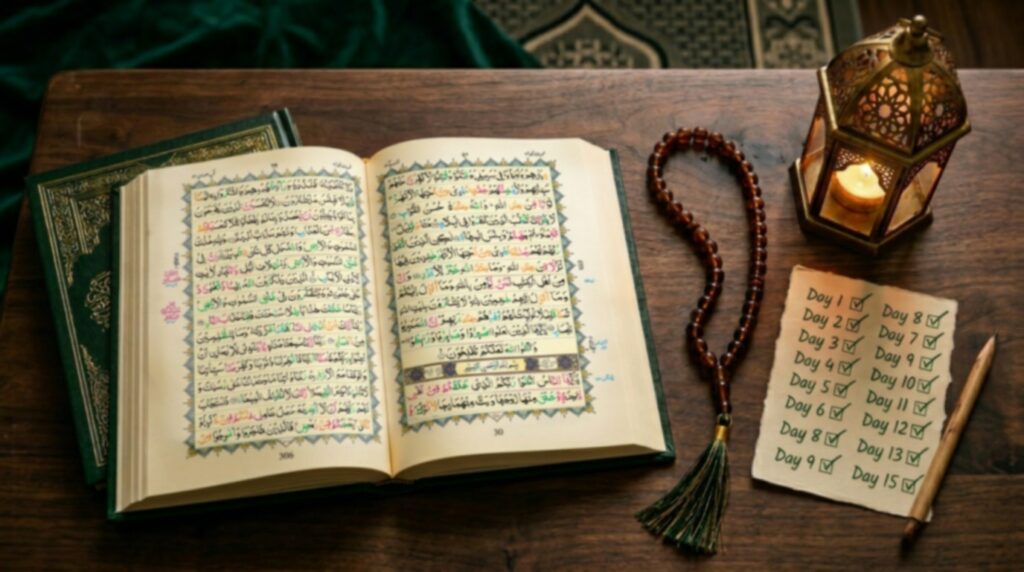
Ramadan is described in the Quran as the month in which the Quran was revealed. The Prophet Muhammad ﷺ would review the entire Quran with the angel Jibreel every Ramadan — and in the final year of his life, he reviewed it twice.
Completing a full recitation of the Quran — a Khatam — in Ramadan is among the most consistent practices of the Muslim community across fourteen centuries. It is not an optional extra or a spiritual achievement reserved for scholars. It is something millions of ordinary Muslims do every year, in every country, at every level of recitation ability.
If you have never done it, or if you have started and not finished in previous Ramadans, this guide is for you. The plan is simpler than you may think. The obstacles are predictable and manageable. And the experience of completing it — of closing the final page of Surah An-Naas on the last night — is one that stays with you.
Why Completing the Quran in Ramadan Matters
The Prophet Muhammad ﷺ said: “The one who recites the Quran and is proficient in it will be with the noble, righteous scribes (angels). And the one who recites the Quran but falters in it — and it is difficult for him — will have two rewards.” (Sahih Muslim)
This hadith is important for two reasons. First, it affirms that recitation — at any level of fluency — carries reward. Second, it is specifically generous to those for whom recitation is difficult: they receive double the reward. Ramadan is not only for those who already recite beautifully.
Completing the Quran in Ramadan is also a commitment to spending time with Allah’s words across the entire month — not just the first excited days or the blessed last ten nights. It creates a structure that carries you through the middle weeks when motivation can dip.
And it produces something that reciting isolated Surahs does not: a sense of the Quran as a whole — the arc of its guidance, the recurring themes, the weight of its completeness.
The Simple Maths: One Juz Per Day
The Quran is divided into 30 Juz (chapters of approximately equal length). Ramadan has 29 or 30 days. The maths is deliberate: one Juz per day completes the Quran in one month.
In the 15-line Madina Mushaf — the most widely used edition — one Juz is approximately 20 pages. At a moderate recitation pace with correct Tajweed, most adults can read 20 pages in 45 minutes to 1 hour.
That is the entirety of what is required: roughly 45-60 minutes of recitation per day, spread across the day. Nothing about this is beyond the capacity of an ordinary Muslim with ordinary commitments — provided it is planned, not left to chance.
A Practical Daily Reading Plan
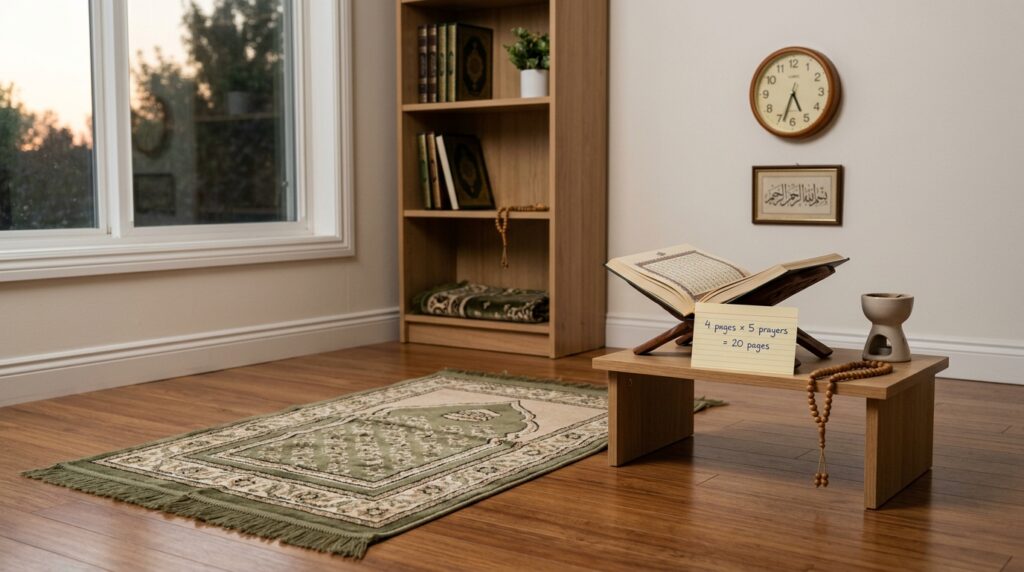
The most reliable way to complete the Quran in Ramadan is to attach recitation to the five daily prayers. Each prayer is already happening — the Quran reading simply joins it.
| Prayer | Pages After Prayer | Approx. Time |
|---|---|---|
| Fajr | 4 pages | 10–12 minutes |
| Dhuhr | 4 pages | 10–12 minutes |
| Asr | 4 pages | 10–12 minutes |
| Maghrib | 4 pages | 10–12 minutes |
| Isha / Taraweeh | 4 pages | 10–12 minutes |
| Daily Total | 20 pages (1 Juz) | 50–60 minutes |
This plan works because it distributes the reading across natural breaks in the day. No single sitting is overwhelming. Each prayer becomes a gateway to 10 minutes of Quran — which most people can sustain even on busy days.
For those who pray Taraweeh: Many mosques recite one Juz in Taraweeh. If you are attending Taraweeh, you may be listening to your daily Juz rather than reading it yourself. Both count. You may choose to read your own Juz in addition, or use the Taraweeh recitation as your daily portion and supplement with additional Surahs during the day.
For working adults: If Dhuhr and Asr readings are not possible at work, shift those pages to after Fajr or before Isha. The total remains 20 pages — the distribution across the day can flex.
What to Do If You Fall Behind
Missing a day happens. Life in Ramadan — with iftar gatherings, family commitments, and fatigue — does not always cooperate with plans made in the first flush of enthusiasm.
The worst response to falling behind is to give up. The second worst response is to attempt an enormous catch-up reading that exhausts you and leaves no energy for the remaining days.
The right response: add 2 to 3 extra pages per sitting for the next few days. If you missed 20 pages (one full day), adding 2 extra pages to each of your 5 daily sittings means you recover the gap in two days. The daily reading becomes 24 pages instead of 20 — manageable, and without breaking the overall structure.
A practical rule: never let a gap grow larger than 2 Juz before addressing it. A 2-Juz gap (40 pages) can be recovered over a week. A 10-Juz gap in the final 10 days cannot — and the pressure of trying creates anxiety rather than devotion.
Quality vs. Quantity — The Right Balance
This is the most common tension in Ramadan Quran reading — and it is worth addressing directly.
Completing the Quran in Ramadan is a meaningful goal. But racing through it at a speed that violates Tajweed — skipping vowel marks, rushing letters, merging words — produces a recitation that does not honour what is being read.
The balance that scholars and experienced teachers consistently recommend: read at the pace that allows correct pronunciation, clear letter articulation, and basic Tajweed rules to be observed — and set your daily target based on that pace.
For some readers, that pace covers 20 pages per day comfortably. For others — particularly those still developing their recitation — 20 pages at a correct pace takes longer than 60 minutes. If that is your situation, a realistic goal might be 15 pages per day — completing 28-29 of the 30 Juz by Eid — rather than rushing through all 30 with poor recitation.
Allah’s words deserve to be recited as they deserve. The goal is meaningful engagement — not a speed record.
If you know your recitation has errors you have never had corrected, Ramadan is also a beautiful time to commit to improving. Our teachers at Suffah Quran Academy are available for Tajweed correction sessions — and the month of the Quran is the most powerful context in which to begin.
A Ramadan Quran Plan for Families With Children
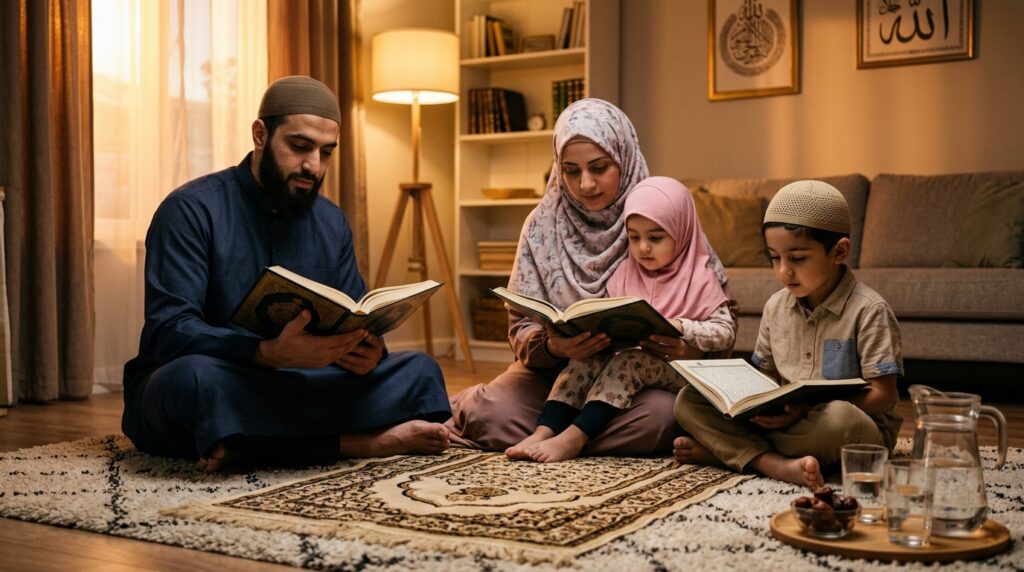
Families with young children face a particular challenge in Ramadan: the adults are fasting, often tired, managing iftar and suhoor, and trying to maintain their own worship — while also making Ramadan meaningful for children who may not yet be fasting.
A few approaches that work for families:
Set a family Quran time. After Maghrib and iftar, before or after Taraweeh, designate 15-20 minutes where everyone sits with their Quran — adults reading their daily portion, children reading whatever is appropriate for their level. The shared practice creates habit and models the value of Quran in a way that words alone cannot.
Give children age-appropriate goals. A child who can read Quran is not expected to complete 30 Juz in Ramadan. A meaningful and achievable goal might be: completing Juz Amma (Juz 30 — the short Surahs most children know), memorising 3 new Surahs, or reading a set number of pages from where they currently are in their Quran lessons. The goal should stretch them slightly without overwhelming them.
Make Taraweeh a family event. Children who attend Taraweeh — even briefly — absorb the atmosphere of Ramadan Quran recitation in a way that stays with them. Even if they only stay for the first few rakats before going home to sleep, the experience is valuable.
Play Quran recitation at home throughout the month. The ambient presence of Quran recitation during Ramadan — at suhoor, during quiet afternoon hours, after iftar — creates an atmosphere that children absorb. By the end of the month, they will have heard portions of the Quran many times without a single formal lesson.
What to Do After Ramadan
The most common post-Ramadan experience is a sharp drop in Quran reading — back to whatever the pre-Ramadan level was, or sometimes lower. This is normal, but it is not inevitable.
The scholars used to say: the sign of an accepted Ramadan is that the person is better after it than before it.
A practical approach to carrying the Ramadan momentum forward:
- Set a post-Ramadan daily minimum. Not 20 pages — that is a Ramadan pace. But 4 pages per day (one sitting after Fajr) maintains a continuous connection with the Quran across the year. At 4 pages per day, you complete the Quran every five months — 2-3 times per year outside of Ramadan.
- Continue or begin Quran lessons. If Ramadan has revealed gaps in your recitation — words you skip, Tajweed rules you are not applying — this is the motivation to address them. The spiritual energy of Ramadan is a powerful starting point for a learning commitment that continues beyond it.
- Keep the family Quran time. If you established a family reading routine in Ramadan, keep it — even at a reduced pace. A 10-minute family Quran sitting after Maghrib every day is a habit worth preserving year-round.
Continue Your Quran Journey After Ramadan
If Ramadan has shown you that your recitation needs improvement — or that your child is ready to begin structured Quran learning — book a free trial class. Our teachers are available year-round, and the momentum from Ramadan is a powerful foundation to build on.
Book Free Trial Class →Frequently Asked Questions
The Quran has 604 pages in the standard 15-line Madina Mushaf. To complete it in 30 days, you need approximately 20 pages (one Juz) per day. A practical approach is 4 pages after each of the 5 daily prayers. This spreads the reading evenly and makes each sitting manageable — around 10-12 minutes per sitting.
Missing a day does not mean the goal is lost. Add 2-3 extra pages to each sitting for the next 3-4 days to recover. Do not try to catch up all in one day — that creates exhaustion. A consistent 20 pages with one missed day recovered gradually is far better than a marathon reading session followed by burnout.
The Quran commands Tarteel — measured, clear, deliberate recitation (Surah Al-Muzzammil 73:4). Reading so fast that Tajweed rules are violated defeats the purpose. A pace that is clear and correct, even if it means completing slightly less than a full Juz on some days, is more valuable than racing through with incorrect recitation.
Children who can read Quran fluently can set age-appropriate Ramadan goals — completing Juz Amma, a specific number of Surahs, or a daily page target that matches their reading speed. The goal is to build the habit and the love, not to achieve a specific quantity that causes stress.
The Prophet Muhammad (peace be upon him) said each letter of the Quran carries ten rewards (Tirmidhi). In Ramadan, good deeds are multiplied. Completing a full recitation (Khatam) in Ramadan is among the most beloved acts of worship in this month — a practice maintained by Muslims since the time of the Companions.
May This Be Your Most Complete Ramadan Yet
The plan is simple. The obstacles are manageable. The only thing between you and completing the Quran this Ramadan is beginning — today, with the first four pages after the next prayer.
And if this Ramadan reveals that your recitation needs strengthening — that there are letters you are not pronouncing correctly, rules you are not applying, passages you are guessing at rather than reading — let that be the gift of this month. The awareness is the beginning of the correction.
Our teachers are here — in Ramadan and beyond it — for exactly that.
Start or Improve Your Quran Journey
Whether you want to strengthen your own recitation or enrol your child — book a free trial class with one of our Ijazah-certified teachers. No payment. No commitment.
Book Free Trial Class →
Written by Ustaz Ahmad Raza
Senior Quran & Tajweed Teacher · 8 Years Experience · Specialisation: Tajweed, Nazra Quran, Madani Qaida
Ustaz Ahmad Raza has over 8 years of experience teaching Quran with Tajweed to children and adults. He specialises in Madani Qaida, Nazra Quran, and basic Islamic studies. His teaching method is simple, patient, and student-friendly. He teaches in Urdu, Hindi, and basic English.
Meet our teaching team →