Estimated reading time: 11 minutes
Table of contents
- What Is an Ijazah?
- How Is an Ijazah Obtained?
- What Does an Ijazah Actually Prove?
- Why Most Quran Teachers Do Not Have Ijazah
- Types of Ijazah
- How to Verify a Teacher’s Ijazah
- A Note on “Certified” vs. “Ijazah-Certified”
- Why It Matters for Your Child
- Frequently Asked Questions
- The Chain Has Been Preserved for 1,400 Years. Your Teacher Should Be Part of It.
When you are looking for a Quran teacher for your child, you will encounter the word Ijazah — often presented as a mark of quality, but rarely explained.
What is an Ijazah? How is it obtained? What does it actually prove about a teacher’s qualifications? And does it matter as much as academies claim it does?
This guide answers all of those questions — clearly and without exaggeration. By the end, you will understand exactly what Ijazah means, why it is important, what its limitations are, and how to verify it before trusting your child’s Quran education to a teacher who claims to hold one.
What Is an Ijazah?
The word Ijazah (إجازة) means permission or authorisation in Arabic. In the context of Quran recitation, it refers to a formal certification that a teacher has:
- Recited the complete Quran with correct Tajweed to a qualified scholar
- Been evaluated and approved by that scholar
- Received permission to teach others — and to pass on the same certification
What makes the Ijazah unique is not just the certification itself — it is the chain of transmission that comes with it.
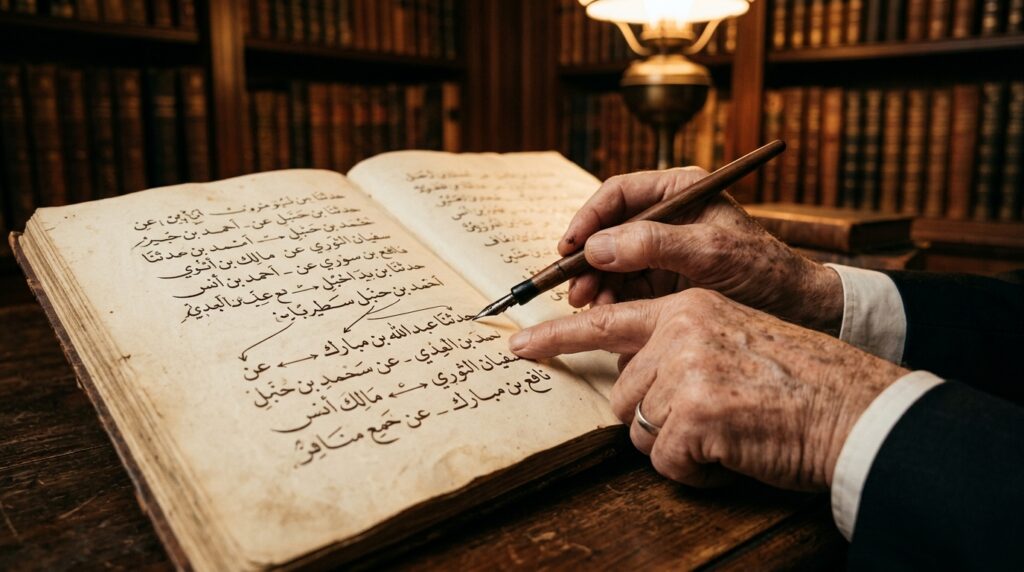
Every Ijazah includes a written chain (called a Sanad — سند) tracing the teacher’s certification back through their teacher, and their teacher’s teacher, and so on — all the way to the Companions of the Prophet Muhammad (peace be upon him), who received the Quran directly from him. The Prophet himself received the Quran through the angel Jibreel, who transmitted it from Allah.
This means that a teacher who holds a valid Ijazah is not just someone who can recite well — they are a verified link in an unbroken chain of transmission stretching back over 1,400 years. The sound of the Quran that they teach has been preserved, corrected, and passed down through that chain, generation by generation.
This is why the Ijazah matters — and why it is not simply equivalent to a degree or a certificate of completion from a Quran course.
How Is an Ijazah Obtained?
Obtaining an Ijazah is not a one-time exam. It is a process — typically extending over months or years — that involves:
Step 1: Complete Quran Recitation to a Scholar The student recites the entire Quran — all 114 Surahs, from Al-Fatiha to An-Naas — directly to a qualified scholar who holds their own Ijazah. The recitation must be in full, with correct Tajweed throughout.
Step 2: Continuous Correction and Evaluation Throughout the process, the scholar listens, corrects, and evaluates. Any Tajweed errors must be identified and resolved. Any letter pronounced from an incorrect Makhraj (articulation point) must be corrected. The standard is high — because the standard of the Sanad that this scholar carries is high.
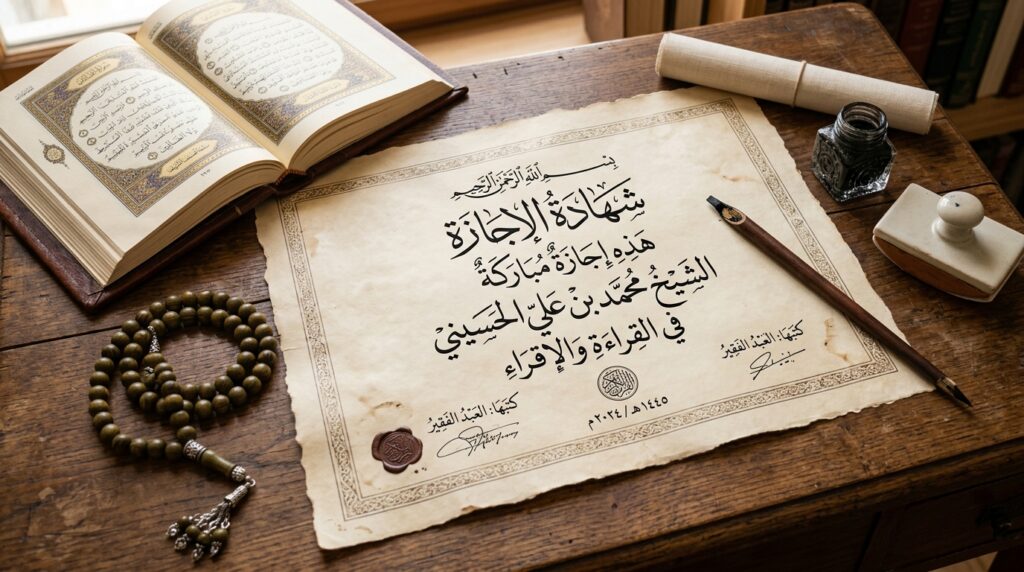
Step 3: Approval and Permission When the scholar is satisfied that the student’s recitation meets the required standard, they grant the Ijazah — formally, in writing, with the Sanad — authorising the student to teach and to pass the certification to their own future students.
Step 4: The Written Certificate The student receives a written Ijazah document — typically in Arabic — specifying their name, the scholar’s name, the Riwaya (recitation style, such as Hafs an Asim), and the full chain of transmission back to the Prophet (peace be upon him).
This process cannot be shortened. There are no shortcuts, no online-only routes, no weekend courses that produce a genuine Ijazah. A scholar who grants an Ijazah is attaching their own name and Sanad to the student’s future teaching — they will only do this when the standard has genuinely been met.
What Does an Ijazah Actually Prove?
An Ijazah certifies three specific things:
Correct Tajweed. The teacher has recited the complete Quran with Tajweed to the satisfaction of a qualified scholar. Their pronunciation has been verified — not self-assessed.
Chain of transmission. The teacher is a verified link in the Sanad — the unbroken chain from the Prophet (peace be upon him). The Quran they teach has been preserved through that chain.
Permission to teach. The scholar who granted the Ijazah has formally authorised the teacher to teach recitation and to grant Ijazah to their own future students.
What an Ijazah does not prove:
Teaching ability. An Ijazah certifies that a person can recite — it does not automatically mean they can teach, particularly to young children. A skilled reciter is not always a patient, effective teacher of beginners.
Character or reliability. Ijazah is a certification of recitation credentials, not a character reference. Parents should still assess a teacher’s manner, patience, and suitability for their child.
Experience. A newly certified Ijazah holder and a teacher with twenty years of experience both hold Ijazah. Experience matters separately.
Understanding these distinctions helps parents ask the right questions — Ijazah is a necessary condition for a qualified Quran teacher, but not a sufficient one on its own.
Why Most Quran Teachers Do Not Have Ijazah
This is the part most academies do not want to discuss.
The majority of people who teach Quran — in community settings, at mosques, through informal arrangements — do not hold a formal Ijazah. This does not mean their recitation is necessarily poor. Many are competent reciters who learned from qualified teachers.
But it does mean:
Their recitation has not been formally verified. They believe their Tajweed is correct. Their teacher believed it was correct. But without the formal evaluation of a scholar through the Ijazah process, there is no independent verification.
They cannot grant Ijazah to their students. This matters more over time — a student who learns from a teacher without Ijazah cannot themselves pursue Ijazah through that teacher.
Errors can propagate. This is the deeper concern. A teacher who has one consistent Tajweed error will teach that error to every student they teach — who may then teach it to their own students. Without the Ijazah system’s formal correction and verification, small errors can compound across generations.
This is not an attack on non-Ijazah teachers. It is a clear-eyed understanding of what the Ijazah system exists to prevent — and why the scholars who designed it did so with the preservation of the Quran as their primary concern.
Types of Ijazah
There are several types of Ijazah in Islamic scholarship. In the context of Quran recitation, the most relevant are:
Ijazah in Riwayat Hafs an Asim: The most common form. Hafs an Asim is the recitation style used in the majority of the Muslim world — the style found in the standard Mushaf printed in Medina and used by most Quran students globally.
Ijazah in the Ten Qira’aat: A more advanced certification covering all ten authentic recitation styles of the Quran. Teachers with this level hold a significantly more comprehensive certification, though it is rarer.
Ijazah in Hifz: Some scholars grant specific Ijazah confirming that a student has memorised the Quran completely and with accuracy. This is different from but related to the Tajweed Ijazah.
For most families enrolling their child in Quran classes, the key question is whether the teacher holds an Ijazah in Riwayat Hafs an Asim — the standard recitation style they will be teaching.
How to Verify a Teacher’s Ijazah

Claiming an Ijazah is straightforward. Verifying one requires asking the right questions.
Ask for the Sanad. A genuine Ijazah includes a written chain of transmission. Ask the teacher to share their Sanad — the list of names connecting them back through their teacher, and their teacher’s teacher, to the original chain. A teacher with a genuine Ijazah will have this documented.
Ask which scholar granted it. The granting scholar’s name should be identifiable. Major scholars who grant Ijazah are typically known within Islamic scholarship communities — their names can be verified.
Ask for the written certificate. A genuine Ijazah is documented in writing, typically in Arabic. A teacher who cannot produce any documentation for their Ijazah claim should be questioned further.
Ask what Riwaya it covers. A teacher should be able to tell you immediately which recitation style their Ijazah covers (typically Hafs an Asim) and what the full scope of the certification includes.
Use your own judgement of their recitation. While you may not be able to evaluate Tajweed at a technical level, you can listen to a teacher recite and note whether their pronunciation is clear, their letters are distinct, and their recitation sounds correct to your ear. A teacher with genuine Ijazah will typically recite with a quality and confidence that is evident even to non-experts.
At Suffah Quran Academy, every teacher holds Ijazah and can provide verification. We are happy to share Sanad details for any teacher upon request — because transparency is central to how we operate.
See our full list of courses and teachers →
A Note on “Certified” vs. “Ijazah-Certified”
In recent years, many online Quran platforms have begun using the word “certified” loosely — referring to certificates from courses, platforms, or institutions that do not involve the traditional Ijazah chain.
These certifications are not worthless — they may reflect genuine training and assessment. But they are not the same as Ijazah, and parents should understand the difference.
An Ijazah is specifically a chain-based certification — it connects the teacher to the Prophet (peace be upon him) through a verified line of transmission. A platform certificate, a course completion certificate, or an institutional diploma does not carry this chain — and therefore does not provide the same guarantee of accuracy that the Ijazah system provides.
When an academy says their teachers are “Ijazah-certified,” ask specifically: do they hold a traditional Ijazah with a Sanad, or a course certificate described as an Ijazah? The distinction matters.
Why It Matters for Your Child
Everything above is important context. But the most practical reason Ijazah matters for your child comes down to this:
A teacher without Ijazah may have errors in their recitation that they are unaware of. Those errors will be taught to your child. Your child will carry those errors, recite Quran with those errors in their daily prayers, and potentially pass them on to their own children.
A teacher with Ijazah has had their recitation formally verified by a qualified scholar who holds a chain of transmission stretching back to the Prophet (peace be upon him). The probability of uncorrected systematic errors is significantly lower.
Your child will spend years learning from their Quran teacher. The foundation that teacher builds will be with them for life. Choosing a teacher whose credentials are verified — not just claimed — is one of the most important decisions you will make for your child’s Islamic education.
Book a free trial class with one of our Ijazah-certified teachers → No payment. No commitment. Just a real class with a teacher whose credentials you can verify.
Frequently Asked Questions
Parents who have learned Quran themselves and can recite with reasonable accuracy often teach their children the basics — particularly short Surahs for prayer. This is a beautiful tradition. However, for structured Quran reading, Tajweed, and Hifz — where systematic errors need to be identified and corrected — a teacher with Ijazah provides a level of verified accuracy that is difficult for a parent without formal certification to match.
Strictly speaking, there is no Islamic law that prohibits teaching Quran without Ijazah. However, the scholarly consensus is that a teacher who instructs others in Quran recitation bears responsibility for the accuracy of what they teach. The Ijazah system exists precisely to provide verification and accountability for that responsibility.
No. An Ijazah certifies that a teacher met the required recitation standard at the time of evaluation. It does not guarantee that their teaching ability, patience, or experience level is the same across all Ijazah holders. A newly certified teacher and a twenty-year veteran both hold Ijazah — experience and teaching skill matter separately.
An Isnad (or Sanad) is the chain of transmission itself — the list of names connecting the teacher to the Prophet (peace be upon him). An Ijazah is the formal certification document that includes the Isnad. The Ijazah is what is granted; the Isnad is the chain it documents.
The evaluation and recitation that leads to Ijazah can take place online — a qualified scholar can listen to a student’s recitation via video call and grant Ijazah if the standard is met. Many Ijazah holders received their certification through a combination of in-person and online recitation sessions. What cannot be done is obtain a genuine Ijazah through a pre-recorded course or without direct evaluation by a qualified scholar.
The Chain Has Been Preserved for 1,400 Years. Your Teacher Should Be Part of It.
The Quran is the most carefully preserved text in human history — preserved not just in writing, but in the voices of millions of Huffaz and teachers who have carried it from generation to generation.
The Ijazah system is how that chain of preservation has been maintained. Every teacher who holds a valid Ijazah is a link in that chain — verified, authorised, and connected to its beginning.
When you choose a teacher for your child, you are choosing which chain they will learn from. Choose one that connects to the source.
Book a free trial class with an Ijazah-certified teacher at Suffah Quran Academy → No payment. No commitment. And yes — we will share our teachers’ Sanad upon request.