
This post contains affiliate links.
Estimated reading time: 11 minutes
Table of contents
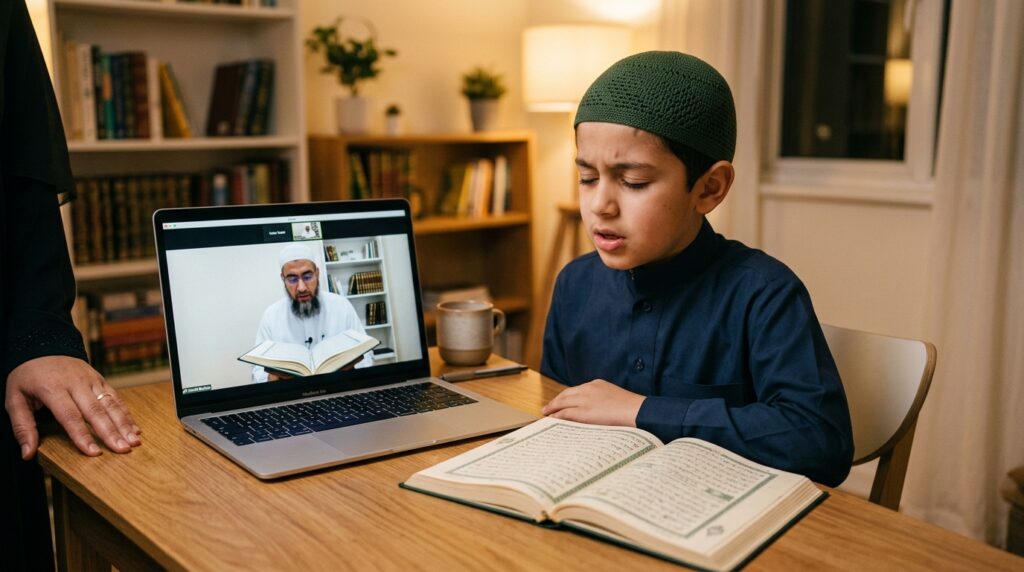
When parents first hear about online Hifz programmes, the most common reaction is scepticism.
Hifz — the complete memorisation of the Quran — has traditionally been taught in dedicated institutions: Hifz schools, madrasas, full-time Islamic boarding environments. The idea that a child can achieve the same result through a screen, from a bedroom, with a teacher hundreds or thousands of miles away — it sounds like a compromise.
Is it?
This article answers that question honestly. Not with marketing language. Not with vague reassurances. With what the evidence actually shows, what experienced Hifz teachers say, what parents who have been through it report — and what conditions need to be in place for online Hifz to work.
The short answer is: yes, online Hifz can be genuinely effective — but not automatically, and not for every child in every situation. The longer answer requires understanding why.
What “Effective” Means for Hifz
Before evaluating whether online Hifz works, we need to agree on what “working” means.
Hifz is not simply getting through the Quran once. It is:
Accurate memorisation — the words are correct, not approximated. Every letter, every vowel mark, every Sukoon is in the right place.
Correct Tajweed — the memorisation is recited with proper pronunciation, applying Tajweed rules consistently throughout.
Durable retention — the memorisation holds over time. A child who memorises Juz 1 correctly and retains it as they progress through Juz 2, 3, 4 — and who can recite the full Quran years after completing it — has achieved Hifz. A child who memorises quickly but forgets at the same rate has not.
Spiritual connection — this is harder to measure, but deeply important to most families. A child who emerges from Hifz with love for the Quran, with a sense of its weight and privilege, has achieved something more than memorisation. A child who emerges burned out and resentful has not — regardless of whether they can technically recite it.
By this definition, effective Hifz is a multi-year commitment to accuracy, Tajweed, retention, and relationship — not a race to completion.
The Evidence: What Research on Online Religious Education Shows
Formal academic research specifically on online Hifz is limited — it is a relatively recent phenomenon and the available literature is mostly in Arabic or Urdu. But broader research on online education and religious instruction provides useful context.
A 2020 review of distance learning outcomes in religious education, cited across multiple Islamic education institutions, found that structured one-on-one online instruction with a qualified teacher produced comparable academic outcomes to in-person instruction — provided three conditions were met:
Daily or near-daily sessions (not weekly or bi-weekly). Active parental involvement in the learning environment at home. A qualified teacher with specific experience in the subject being taught — not a generalist.
When these conditions were present, the medium of delivery — online vs. in-person — was not a significant variable in outcomes. When any of these conditions were absent, outcomes dropped significantly regardless of format.
This aligns closely with what Hifz teachers who work online consistently report.
What Experienced Online Hifz Teachers Say
Teachers who have guided students through complete Hifz online — not just partial memorisation, but to the completion of all 30 Juz — consistently identify the same factors that determine success.
Teacher experience with Hifz specifically matters enormously.
A teacher who is an excellent Quran reading instructor is not automatically an effective Hifz teacher. Hifz requires a specific pedagogical approach — knowing how much to give a student each day, how to manage the Sabaq-Sabqi-Manzil revision system, how to identify when a student is on the edge of burnout, and how to pace the journey across years, not weeks. Online Hifz teachers who have themselves completed Hifz and have guided multiple students to completion bring an experiential understanding that cannot be substituted.
Daily consistency is more important than session length.
A student who has a 30-minute session every day progresses more reliably than a student who has a 2-hour session twice a week. The daily repetition of Sabaq, Sabqi, and Manzil — maintained without significant gaps — is what produces durable memorisation. Online programmes that offer only two or three sessions per week and expect the same results as daily programmes are misleading families.
What happens at home between sessions is the primary variable.
This is the finding that surprises parents most. In in-person Hifz schools and madrasas, the environment provides structure — the student is surrounded by other students, a teacher is physically present, and there is an institutional culture that supports the work. At home, this environment must be consciously created by parents.
A child who recites their Sabaq to a parent every evening, who has a protected revision time built into their daily routine, and whose family makes the Hifz a shared priority — that child will almost always make genuine progress online. A child who is left entirely to their own discipline between sessions will typically struggle, regardless of how good the teacher is.
The Mushaf the child uses matters.
Online Hifz teachers strongly recommend that the child use a single consistent Mushaf throughout — ideally the 15-line Madina Mushaf that most Hifz students use, so that the visual layout of the page is consistent. The brain encodes memorisation partly through visual memory — which page, which position on the page. Switching between different Qurans or using screens exclusively for recitation disrupts this.
What Parents Who Have Done It Report
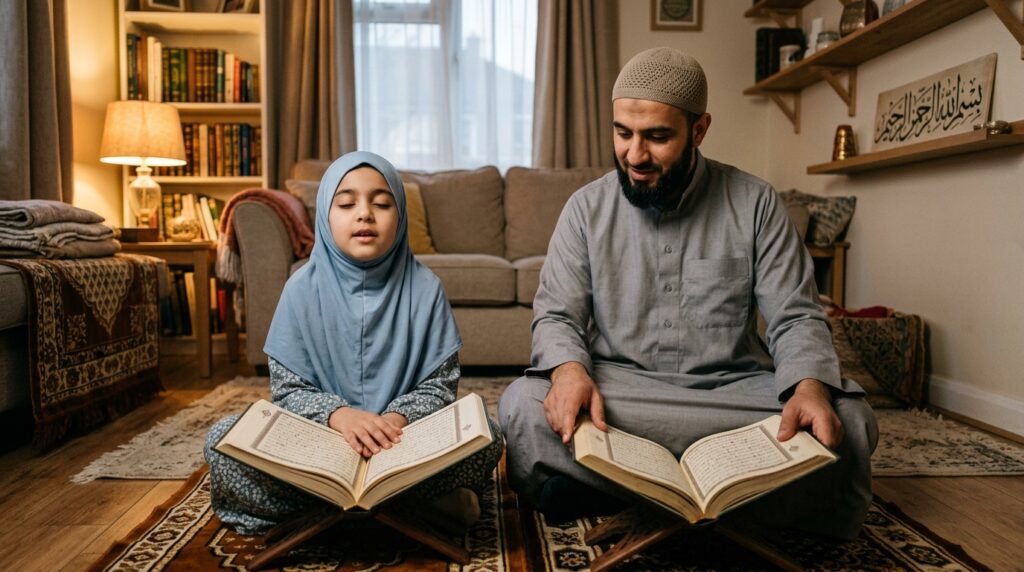
Across parent communities in the UK, USA, Canada, and Australia where online Hifz has been underway for several years, consistent themes emerge from families whose children have progressed successfully:
It takes longer than in-person full-time programmes — typically 4-7 years for part-time online Hifz, compared to 2-4 years for full-time residential programmes. Parents who are realistic about this from the start are more likely to maintain the consistency required.
The teacher relationship is critical — and this is as true online as in person. Children who build a genuine relationship with their Hifz teacher — who look forward to the class, who feel the teacher knows them and cares about their progress — persist through difficult periods. Children who have a distant or purely transactional relationship with their teacher struggle when the going gets hard.
The first six months are the hardest — establishing the routine, learning the revision system, adjusting to the sustained daily commitment. Families who get through the first six months consistently almost always continue to completion.
Parents underestimate their own role — nearly every parent who reflects on a successful online Hifz journey emphasises that their daily listening and involvement was not a supplement to the teacher’s work — it was an equal part of it.
When Online Hifz Is Less Likely to Work
In the interest of honesty, here are the situations where online Hifz is unlikely to be effective — and where families should either wait, or consider a different format:
The child cannot read Quran fluently with correct Tajweed. This is non-negotiable. A student who struggles with reading cannot memorise correctly. The errors become embedded and are extremely difficult to correct later. Establish reading first — then begin Hifz.
The family cannot commit to daily sessions. If work, school, and life circumstances make daily online sessions impossible to maintain consistently — online part-time Hifz will produce slow, inconsistent results. Consider whether the timing is right, or whether a more limited memorisation goal (completing Juz Amma thoroughly, for example) might be more realistic for now.
The child is under 7 and not yet settled into learning routines. Very young children can begin memorisation — but Hifz requires a level of daily discipline that many children under 7 are not yet ready for. Starting too early, before a child is genuinely ready, risks creating negative associations with the Quran. Establish Madani Qaida and early Quran reading first.
The programme offers only 2-3 sessions per week and calls it Hifz. Some online platforms offer infrequent sessions and market them as Hifz programmes. With 2-3 sessions per week and no intensive home revision system, meaningful Hifz progress is very slow and the memorisation typically does not hold. Genuine online Hifz requires near-daily contact with the teacher, supplemented by daily home revision.
There is no parental involvement at home. If parents are not available to listen to their child’s revision, support the routine, and engage with the teacher’s guidance — online Hifz will struggle. This is not a criticism — it is a practical reality. If your life circumstances do not currently allow for this level of involvement, it is better to know that upfront than to start and stop.
What a Good Online Hifz Programme Looks Like
For families for whom online Hifz is the right choice — or the only accessible option — here is what a serious, effective programme should include:
Daily or near-daily sessions (5-6 per week at minimum for meaningful progress).
A structured Sabaq-Sabqi-Manzil system that the teacher manages and tracks — not just “recite new material and move on.”
A qualified teacher who has completed Hifz themselves and who has guided other students to completion — not just to significant progress.
Regular parent communication — monthly or fortnightly updates on which sections are memorised, which are in revision, where the child is strong or weak.
Recorded sessions so parents can review what was covered and check their child’s recitation against the teacher’s correction.
A clear, honest conversation upfront about realistic timelines, the parent’s role, and what will be required — not vague promises about fast completion.
At Suffah Quran Academy, our Hifz teachers are themselves Huffaz, experienced in guiding students through the full memorisation journey. We use the Sabaq-Sabqi-Manzil system daily and keep parents closely informed throughout.
Learn more about our Hifz ul Quran programme →
Frequently Asked Questions
Yes — children have completed full Hifz through structured online programmes. The medium matters less than the conditions: a qualified teacher with Hifz experience, near-daily sessions, a structured Sabaq-Sabqi-Manzil revision system, and active daily parental involvement at home. When all these are in place, online Hifz produces genuine, durable Huffaz.
Effective online Hifz requires 5-6 sessions per week — near-daily contact with the teacher. Programmes offering only 2-3 sessions per week and calling it Hifz will produce very slow progress and memorisation that typically does not hold. The daily Sabaq (new lesson), Sabqi (recent revision), and Manzil (long-term revision) cannot be maintained effectively on an infrequent schedule.
Part-time online Hifz typically takes 4-7 years for most children — longer than full-time residential programmes (2-4 years) but a realistic and achievable timeframe for families managing mainstream school alongside Hifz. Daily consistency is the biggest factor: a child who never misses will always progress faster than one with frequent gaps.
Parents play an essential role that cannot be delegated to the teacher. The most important parental tasks are: listening to the child recite their daily Sabaq before or after the class, supporting the revision routine at home, maintaining a protected daily Hifz time, and staying in regular communication with the teacher about progress and challenges.
No — fluent Quran reading with correct Tajweed is a non-negotiable prerequisite for Hifz. A child who struggles with reading will embed errors into their memorisation that become very difficult to correct later. Establish reading first through Madani Qaida and Quran Reading with Tajweed, then begin Hifz. Read our guide on what is Hifz ul Quran for full prerequisites.
Yes — adults can pursue and complete Hifz online. The prerequisites are the same: fluent Quran reading with Tajweed, daily commitment, and a qualified teacher. Adults typically have stronger concentration and motivation than young children, which can compensate for the slightly less plastic adult memory. The timeline is similar to or slightly longer than for older children.
The Honest Verdict
Online Hifz is not a lesser version of in-person Hifz. It is a different context for the same work — and when the right conditions are in place, it produces genuine Huffaz.
Those conditions are: a qualified, experienced Hifz teacher; near-daily sessions; a structured revision system; a consistent Mushaf; and active, daily parental involvement at home.
Without all of these, results are unreliable — in any format, online or otherwise.
For Muslim families in the West who cannot access dedicated Hifz schools — and for many families, this describes their situation accurately — a well-structured online Hifz programme, pursued consistently over several years, is a genuine and honourable path to completing the memorisation of Allah’s book.
The journey is long. It demands more from your family than most things will. But what it produces — a child who carries the complete Quran in their heart — is among the most extraordinary things a Muslim family can experience together.
Book a free trial Hifz class to discuss your child’s readiness with one of our teachers → No payment. No commitment. An honest conversation about whether online Hifz is the right fit for your family right now.