

This post contains affiliate links.
Estimated reading time: 13 minutes
Table of contents
- What Is Tajweed?
- CATEGORY 1: Rules of Noon Sakinah and Tanween
- CATEGORY 2: Rules of Meem Sakinah
- CATEGORY 3: Rules of Madd (Prolongation)
- Rule 9: Madd Tabee’i (Natural Prolongation — مد طبيعي)
- Rule 10: Madd Wajib Muttasil (Obligatory Connected Prolongation — مد واجب متصل)
- Rule 11: Madd Jaiz Munfasil (Permissible Separated Prolongation — مد جائز منفصل)
- Rule 12: Madd Aarid Lissukoon (Prolongation Due to Stopping — مد عارض للسكون)
- Rule 13: Madd Lazim (Compulsory Prolongation — مد لازم)
- CATEGORY 4: Ghunnah (Nasal Sound)
- CATEGORY 5: Qalqalah (Echo Sound)
- CATEGORY 6: Rules of Laam
- CATEGORY 7: Rules of Waqf (Stopping)
- CATEGORY 8: Characteristics of Letters (Sifaat)
- A Note on Learning Tajweed in Practice
- Frequently Asked Questions
- Keep This Reference. Come Back to It.
Tajweed is not a single rule. It is a system — a set of rules that, when applied together, produce the correct and beautiful recitation of the Quran that Allah’s words deserve.
For beginners, this system can feel overwhelming. There are many rules, many Arabic terms, and many subtleties. Most beginner resources either oversimplify to the point of uselessness — or go so deep that the learner closes the tab after five minutes.
This reference is designed to be different: complete enough to be genuinely useful, simple enough to actually be understood.
Use this as a reference to come back to. Bookmark it. Print it if that helps. As you progress through your Quran learning, each rule here will begin to make more sense in practice — and this list will help you name and remember what you are learning.
What Is Tajweed?
Before the rules, a brief foundation.
The word Tajweed (تجويد) comes from the Arabic root meaning to make something excellent or to do something well. In the context of Quran recitation, Tajweed refers to the set of rules that govern how each letter of the Quran is pronounced — its exact sound, its duration, its interaction with neighbouring letters, and the characteristics that make it distinct.
The Prophet Muhammad (peace be upon him) received the Quran through the angel Jibreel with specific pronunciation — and he taught his Companions to recite it the same way. That recitation has been preserved through an unbroken chain of teachers to the present day. Tajweed rules are the codification of that preserved tradition.
Applying Tajweed is obligatory (Fardh) when reciting the Quran. Reciting without Tajweed is not sinful for someone still learning — but the intention and effort to learn correctly is required.
Now to the rules.
CATEGORY 1: Rules of Noon Sakinah and Tanween
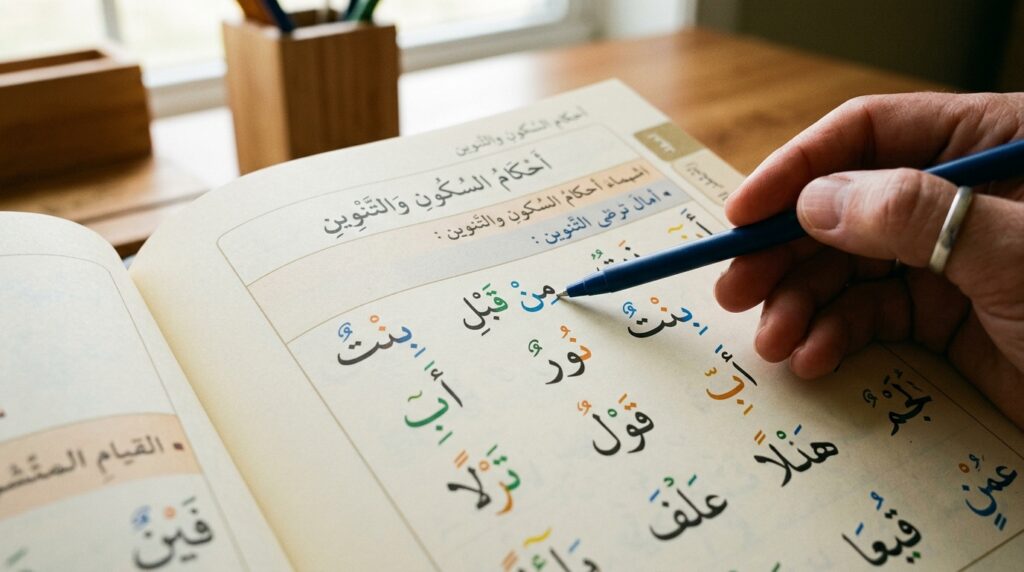
Noon Sakinah (نْ) is the letter Noon with a Sukoon — no vowel. Tanween (ـً ـٍ ـٌ) refers to the double vowel marks at the end of words that produce an “n” sound.
Both are governed by the same four rules, depending on the letter that follows them.
Rule 1: Idghaam (Merging — إدغام)
When: Noon Sakinah or Tanween is followed by one of these six letters: ي ر م ل و ن (Ya, Ra, Meem, Lam, Waw, Noon)
What happens: The Noon sound merges into the following letter. The Noon is not pronounced separately.
Two types:
- Idghaam with Ghunnah (nasal sound): when followed by ي و م ن
- Idghaam without Ghunnah: when followed by ل ر
Example: مِنْ يَوْمٍ — the Noon merges into the Ya. You do not say “min yawm” with a clear N — the N blends.
Memory tip: Think of it as the Noon “disappearing” into the next letter.
Rule 2: Idghaam — Special Case (Same Letter)
When: Noon Sakinah is followed by another Noon, or Tanween is followed by a Noon.
What happens: The two Noons merge with a strong Ghunnah (nasal sound held for 2 counts).
Rule 3: Iqlaab (Substitution — إقلاب)
When: Noon Sakinah or Tanween is followed by the letter Baa (ب)
What happens: The Noon sound changes to a Meem sound — with Ghunnah. The lips close gently.
Example: مِنْ بَعْدِ — the Noon before Baa becomes a Meem sound: “mim ba’di”
Memory tip: Noon turns into Meem before Baa. There is only one letter that triggers Iqlaab — Baa
Rule 4: Ikhfaa (Concealment — إخفاء)
When: Noon Sakinah or Tanween is followed by any of 15 specific letters (not the Idghaam or Iqlaab letters, not Hamza or Ha)
The 15 Ikhfaa letters: ص ذ ث ك ج ش ق س د ط ز ف ت ض ظ
What happens: The Noon is neither fully pronounced nor fully merged. It is concealed — a nasal sound between the two. The tongue does not touch the roof of the mouth for the Noon. Ghunnah is maintained for approximately 2 counts.
Example: مِنْ كُلِّ — the Noon before Kaaf goes into Ikhfaa state.
Memory tip: Ikhfaa is the most common rule and covers the largest number of letters. When in doubt about which rule applies — if the following letter is not one of the Idghaam, Iqlaab, Izhar, or Hamza/Ha letters — it is likely Ikhfaa.
Rule 5: Izhar (Clear Pronunciation — إظهار)
When: Noon Sakinah or Tanween is followed by one of the six throat letters (Huroof Halq): ء ه ع ح غ خ
What happens: The Noon is pronounced clearly and completely. No merging, no concealment, no nasal extension.
Example: مِنْ عِلْمٍ — the Noon is pronounced clearly before Ain.
Memory tip: Izhar = clear. Throat letters = clear Noon. These are the six letters produced from the throat — so the Noon sounds out fully before them.
CATEGORY 2: Rules of Meem Sakinah
Meem Sakinah (مْ) is the letter Meem with a Sukoon. It has three rules depending on the following letter.
Rule 6: Ikhfaa Shafawi (Labial Concealment — إخفاء شفوي)
When: Meem Sakinah is followed by Baa (ب)
What happens: The Meem is concealed — lips close but do not press firmly. A nasal Ghunnah sound is held for 2 counts.
Example: وَهُمْ بِالآخِرَةِ — Meem before Baa goes into Ikhfaa Shafawi.
Why “Shafawi”: Shafa means lips in Arabic. This rule involves the lips.
Rule 7: Idghaam Shafawi (Labial Merging — إدغام شفوي)
When: Meem Sakinah is followed by another Meem (م)
What happens: The first Meem merges into the second with a strong Ghunnah held for 2 counts.
Example: لَهُمْ مَا — the two Meems merge into one with nasal extension.
Rule 8: Izhar Shafawi (Labial Clear Pronunciation — إظهار شفوي)
When: Meem Sakinah is followed by any letter other than Baa or Meem
What happens: The Meem is pronounced clearly. No merging, no concealment.
Important note: Extra care is needed when Meem Sakinah is followed by Waw (و) or Fa (ف) — because these involve the lips as well. The Meem must be clear and distinct.
CATEGORY 3: Rules of Madd (Prolongation)
Madd rules govern how long certain sounds are held. Duration is measured in “counts” — approximately the time it takes to open or close a finger naturally.
Rule 9: Madd Tabee’i (Natural Prolongation — مد طبيعي)
Duration: 2 counts
When: Any of the three Madd letters (ا و ي) follows a letter with the corresponding vowel, with no Hamzah or Sukoon immediately after.
This is the baseline Madd. Every longer Madd is a variation or extension of this.
Example: The Alif in قَالَ, the Waw in يَقُولُ, the Ya in قِيلَ — each held for 2 counts.
Rule 10: Madd Wajib Muttasil (Obligatory Connected Prolongation — مد واجب متصل)
Duration: 4-5 counts (obligatory — cannot be shortened)
When: A Madd letter is immediately followed by a Hamzah (ء) within the same word.
Example: جَاءَ — the Alif before Hamzah is held for 4-5 counts.
Why obligatory: The Hamzah creates a strong “pull” on the preceding Madd. This prolongation is required — hence Wajib.
Rule 11: Madd Jaiz Munfasil (Permissible Separated Prolongation — مد جائز منفصل)
Duration: 2, 4, or 5 counts (flexible — reader chooses consistently)
When: A Madd letter at the end of one word is followed by a Hamzah at the beginning of the next word.
Example: إِنَّا أَعْطَيْنَاكَ — the Alif at the end of إِنَّا before the Hamzah of أَعْطَيْنَاكَ.
Why Jaiz: The separation between words allows flexibility.
Rule 12: Madd Aarid Lissukoon (Prolongation Due to Stopping — مد عارض للسكون)
Duration: 2, 4, or 6 counts (when stopping at that word)
When: A Madd letter is followed by a letter that carries a vowel — but the reciter is stopping at that word (Waqf). The final letter gets a temporary Sukoon when stopped upon.
Example: Stopping on الرَّحِيمِ — the Ya before Meem can be held for 2, 4, or 6 counts.
This is one of the most commonly heard Madd rules in recitation.
Rule 13: Madd Lazim (Compulsory Prolongation — مد لازم)
Duration: 6 counts (compulsory — cannot be changed)
When: A Madd letter is followed by a letter with a Shaddah, or a letter with Sukoon that is never dropped (whether stopping or continuing).
Example: الضَّالِّينَ — the Alif before the Lam with Shaddah is held for 6 counts.
Why Lazim: Lazim means compulsory. 6 counts — always.
CATEGORY 4: Ghunnah (Nasal Sound)
Rule 14: Ghunnah (الغنة)
Ghunnah is the nasal resonance that comes from the nasal cavity — not the mouth or throat. It accompanies several Tajweed rules.
Duration: 2 counts (approximately)
Letters with natural Ghunnah: Meem (م) and Noon (ن) — whenever they carry a Shaddah.
Example: إِنَّ — the Noon with Shaddah is held with nasal resonance for 2 counts. اللّٰهُمَّ — the Meem with Shaddah similarly.
Important: Ghunnah is produced from the nose, not the throat. Pinch your nose while reciting — if the sound changes, you are producing correct Ghunnah.
CATEGORY 5: Qalqalah (Echo Sound)
Rule 15: Qalqalah (القلقلة)
Letters: Five specific letters — ق ط ب ج د (often remembered by the phrase: قُطْبُ جَدٍّ)
What it is: When any of these five letters carries a Sukoon — either in the middle of a word or when stopped upon at the end — a slight bouncing or echoing sound is produced. The letter is not held silently; it has a vibration.
Two types:
- Qalqalah Sughra (minor): the letter has Sukoon in the middle of a word while continuing recitation
- Qalqalah Kubra (major): the letter is at the end of a word and the reciter stops there — the echo is stronger
Example: يَقْطَعُونَ — the Qaaf with Sukoon has Qalqalah. Stopping on كَسَبَ — the Baa has strong Qalqalah.
CATEGORY 6: Rules of Laam
Rule 16: Laam Shamsiyyah and Laam Qamariyyah
The definite article “Al” (ال) in Arabic has two pronunciations depending on the letter that follows it.
Laam Shamsiyyah (Solar Laam — لام شمسية): When Al is followed by one of 14 “solar” letters, the Laam is not pronounced — it assimilates into the following letter, which is then pronounced with Shaddah.
The 14 solar letters: ت ث د ذ ر ز س ش ص ض ط ظ ل ن
Example: الشَّمْسُ (Al-Shamsu) — the Laam disappears, Sheen is doubled: “Ash-Shamsu”
Laam Qamariyyah (Lunar Laam — لام قمرية): When Al is followed by one of 14 “lunar” letters, the Laam is pronounced clearly.
Example: الْقَمَرُ (Al-Qamaru) — the Laam is clear: “Al-Qamaru”
Memory tip: “Shams” (sun) starts with a Shamsiyyah letter — the Laam disappears in its own name. “Qamar” (moon) starts with a Qamariyyah letter — the Laam is clear.
CATEGORY 7: Rules of Waqf (Stopping)
Rule 17: Rules of Stopping (Waqf — الوقف)
Waqf refers to the rules governing where and how a reciter may stop in Quranic recitation.
Four key stopping symbols in the Mushaf:
- مـ (Waqf Laazim): Compulsory stop. Stopping is required here; continuing would change the meaning.
- لا (Laa Waqf): Do not stop here — continuing is required for correct meaning.
- ج (Jaiz): Permissible to stop or continue.
- قف (Qif): Stop here (some scholars prefer stopping at this point).
When stopping, the final letter:
- Takes a Sukoon (if it had a vowel)
- Feminine Ta Marbuta (ة) becomes Ha sound when stopped
- Tanween endings drop the Noon sound when stopped
When stopping is not permissible: Never stop at a point that changes or corrupts the meaning of the verse — even if the stop signs would technically permit it. Understanding the meaning, even at a basic level, protects the integrity of recitation.
CATEGORY 8: Characteristics of Letters (Sifaat)
Rule 18: Tafkheem and Tarqeeq (Heavy and Light Pronunciation)
Some Arabic letters are naturally “heavy” — pronounced with the back of the mouth raised, giving a deep, rounded sound. Others are “light” — pronounced with the mouth in a neutral or forward position.
Letters with permanent Tafkheem (always heavy): خ ص ض غ ط ق ظ
These letters are always heavy regardless of their vowel.
The letter Raa (ر) — context-dependent: Raa is heavy (Tafkheem) when it carries a Fathah or Dhammah, or when it has Sukoon after a Fathah or Dhammah. Raa is light (Tarqeeq) when it carries a Kasrah, or has Sukoon after a Kasrah.
The letter Laam in the Name of Allah (ل in لله): The Laam in Allah’s name is heavy when preceded by a Fathah or Dhammah: اللهُ — heavy Laam. It is light when preceded by a Kasrah: بِسْمِ اللهِ — light Laam.
A Note on Learning Tajweed in Practice

Reading rules from a reference is a starting point — not a destination. Tajweed is a practical skill that must be heard and corrected to be learned properly.
The rules above can be studied and understood intellectually. But applying them correctly in the flow of recitation — where decisions happen in real time, at the pace of natural reading — requires a teacher who can hear you and correct you.
This is why the Ijazah system exists. Every qualified Quran teacher received their Tajweed correction from a teacher, who received it from a teacher — all the way back. The sound itself has been preserved and transmitted, not just the written rules.
Use this reference to understand what you are learning. Use a qualified teacher to learn to apply it.
Our teachers at Suffah Quran Academy are Ijazah-certified in Tajweed — book a free trial class to experience corrected Tajweed teaching directly.
For a deeper look at what Tajweed is and why it matters, read our beginner’s guide: What Is Tajweed and Why Does It Matter?
Frequently Asked Questions
The core Tajweed rules that most beginners need to learn number around 15-20, covering Noon Sakinah, Tanween, Meem Sakinah, Madd, Ghunnah, Qalqalah, Waqf, and letter characteristics. Advanced Tajweed study goes significantly deeper — into Sifaat (letter characteristics), Makhaarij (articulation points), and subtle rules of interaction between specific letters. This reference covers the rules most beginners encounter first.
No. Tajweed rules are learned progressively — typically through recitation practice, with a teacher pointing out rules as they apply in the text being read. Understanding the rules helps you learn faster, but the goal is correct recitation, not the ability to recite all rules from memory.
Tarteel refers to a calm, measured, and reflective pace of recitation — as commanded in the Quran (73:4). Tajweed refers to the pronunciation rules applied during that recitation. Tarteel is about pace and manner; Tajweed is about correctness of sound. Both are required for ideal Quranic recitation.
Makhaarij (مخارج) refers to the specific points in the mouth and throat from which each Arabic letter is produced. There are 17 primary articulation points. Learning Makhaarij is the foundation of correct Tajweed — before you can apply rules about how letters interact, you need to produce each letter correctly from its correct point. A qualified Tajweed teacher will teach Makhaarij systematically.
Yes — and for learners without access to local qualified teachers, online one-on-one Tajweed instruction is highly effective. The key is that the teacher can hear you recite in real time and correct you immediately. Pre-recorded videos and written rules alone cannot teach Tajweed — live correction is essential.
Scholars have stated that applying Tajweed is obligatory (Fardh Ayn) — but a beginner who is actively learning is not sinful for making mistakes during the learning process. What is required is the intention and effort to learn correctly. Deliberately neglecting Tajweed after having the means to learn it is another matter.
Keep This Reference. Come Back to It.
Tajweed takes time. No one learns all of these rules in a single sitting, and no one applies them all perfectly from the beginning.
What matters is consistent practice with a qualified teacher — someone who can hear the difference between your Ikhfaa and your Izhar, who can tell whether your Qalqalah has the right bounce, who can confirm that your Ghunnah is coming from the nose and not the throat.
This reference exists to name and explain what you are learning. The learning itself happens in recitation — with a teacher, with patience, with time. If you want a simple way to structure that practice, our 15-minute daily tajweed practice routine lays out exactly what to drill each day, minute by minute.
Book a free Tajweed class with one of our Ijazah-certified teachers → No payment. No commitment. A real session where you recite and receive real correction.