This post contains affiliate links.
Estimated reading time: 10 minutes
Table of contents
- What Is a Qaida?
- What Is Madani Qaida Specifically?
- What Does Madani Qaida Teach? (Step by Step)
- Madani Qaida vs Noorani Qaida — What’s the Difference?
- How Long Does Madani Qaida Take to Complete?
- What a Typical Madani Qaida Class Looks Like
- What Comes After Madani Qaida?
- How Parents Can Support Madani Qaida at Home
- A Note for Parents Whose Children Are Struggling
- Frequently Asked Questions
- The Foundation Everything Else Is Built On
If you’ve spoken to a Quran teacher about enrolling your child, you’ve almost certainly heard the word Qaida — and probably Madani Qaida specifically.
But what exactly is it? Is it a book? A method? A course? And why do so many qualified teachers insist on starting here, rather than going straight to the Quran?
This guide answers all of those questions. By the end, you’ll understand exactly what Madani Qaida is, what your child will learn through it, how long it takes, and why it remains the most trusted starting point for Quran education across the world.
What Is a Qaida?
Before we get to Madani Qaida specifically, let’s understand what a Qaida is.
The word Qaida (قاعدة) means rule or foundation in Arabic. In the context of Quran education, a Qaida is a structured beginner’s course — a step-by-step method for teaching someone who has never encountered Arabic script before how to recognise letters, understand their sounds, and eventually read Arabic text correctly.
Think of it like a phonics programme for Arabic. Just as English-speaking children learn the sounds of letters before they read words, a Qaida teaches Arabic sounds and letters before a child reads the Quran.
The effectiveness of structured phonics-based approaches to early literacy is well established in educational research — documented by the UK Department for Education’s reading framework (https://www.gov.uk/government/publications/teaching-children-to-read).
Without this foundation, a child who starts reading the Quran directly will either guess at pronunciation, develop habits that are very difficult to correct later, or struggle and lose confidence — creating negative associations with Quran learning that take years to undo. A proper Qaida prevents all of this.
What Is Madani Qaida Specifically?
Madani Qaida is one particular Qaida — and among qualified Quran teachers, it is widely regarded as the most comprehensive and effective one available.
It was developed by Islamic scholars associated with the dawateislami tradition (http://dawateislami.net/) and refined over decades of classroom use. The name Madani references Medina — the city of the Prophet (peace be upon him) — and reflects the aspiration that students learn to recite as those closest to the Prophet recited.
What makes Madani Qaida distinctive is its progression. It does not simply introduce Arabic letters and move on. It takes the student through a carefully ordered sequence that builds each skill on top of the previous one — so that by the time a student completes it, they are not just recognising letters but reading connected Arabic text with correct sounds.
What Does Madani Qaida Teach? (Step by Step)
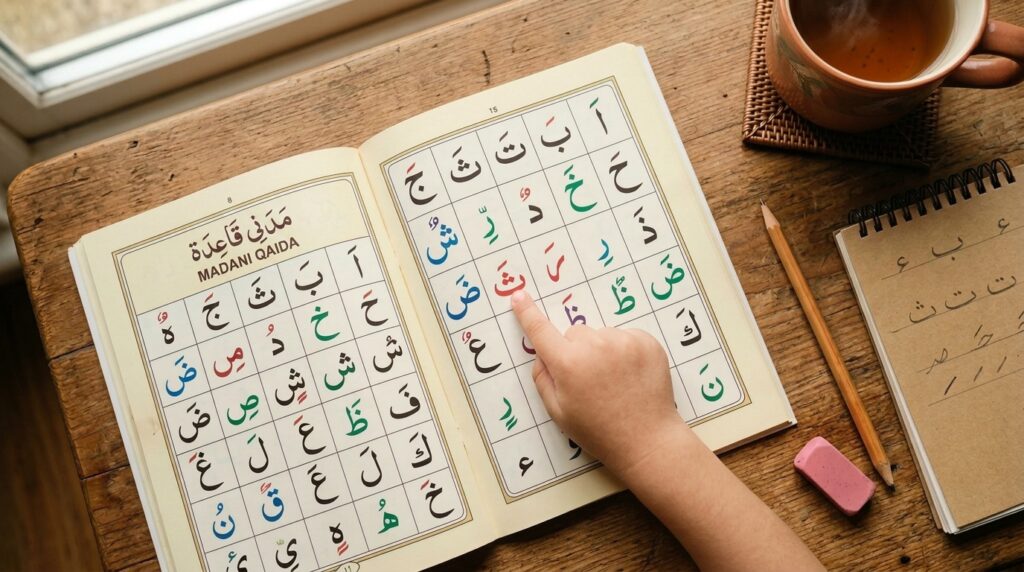
A complete Madani Qaida course moves through these stages in order:
Stage 1: Individual Arabic Letters
The student learns each of the 29 Arabic letters — their name, their shape, and their basic sound. This stage also teaches the student how to distinguish between letters that look similar but differ in their dots — like ba, ta, and tha. For non-Arab learners, this visual discrimination is one of the most important early skills.
Stage 2: Letters With Vowel Marks (Harakat)
Arabic letters alone do not tell you how to pronounce a word — the vowel marks do that. This stage introduces the three short vowels: Fathah (the “a” sound), Kasrah (the “i” sound), and Dhammah (the “u” sound). By the end of this stage, a child can look at any Arabic letter with a vowel mark and produce the correct sound.
Stage 3: Sukoon — Letters Without Vowels
Sukoon is the mark placed on a letter that has no vowel sound — meaning the letter is “stopped.” This stage teaches students how to read such letters correctly, which is essential for Tajweed and for reading Arabic text fluently.
Stage 4: Tanween
Tanween refers to the double vowel endings that appear at the ends of Arabic words — producing sounds like -an, -in, and -un. This stage prepares students for correct recitation of Quranic endings.
Stage 5: Madd Letters — Prolongation
Some Arabic letters, when combined with certain vowels, produce a prolonged sound. This stage introduces the three Madd letters — waw, ya, and alif — and teaches students when and how to extend the sound. This is the beginning of Tajweed — specifically the rules of prolongation.
Stage 6: Shadda — Doubled Letters
Shadda is the mark that doubles a letter, giving it extra emphasis in pronunciation. Students learn to recognise the Shadda mark and produce the correct sound — a skill that directly affects the meaning of Quranic words.
Stage 7: Joined Letters and Word Reading
Here the learning becomes exciting: individual letters are now joined together into words, and the student reads their first actual Arabic words. The sense of accomplishment at this stage is significant — many children who have been progressing slowly through letters suddenly feel a surge of confidence when they read their first complete word.
Stage 8: Short Quranic Phrases and Sentences
In the final stage, students begin reading short phrases directly from the Quran — short ayaat from Juz Amma, familiar phrases, and simple sentences. By this point, the student is no longer a complete beginner. They are reading.
Madani Qaida vs Noorani Qaida — What’s the Difference?
Parents often ask about the difference between Madani Qaida and Noorani Qaida, as both are widely used. Both are excellent beginner foundations. Here is how they differ:
Madani Qaida: Origin from the Darul Uloom tradition. More gradual, highly structured progression. Tajweed rules woven in from early stages. Best for younger children who need careful progression. Common in South Asian diaspora communities.
Noorani Qaida: Developed by Sheikh Noor Muhammad Haqqani. Structured but slightly faster pace. Tajweed integrated from the very start. Suits slightly older or quicker learners. Widely used across multiple communities.
Neither is definitively better — the right choice depends on the individual child and the teacher’s expertise. At Suffah Quran Academy, our teachers are trained in Madani Qaida and will assess your child in the free trial class to confirm it is the right fit.
How Long Does Madani Qaida Take to Complete?
The honest answer is: it varies. The main factors are age, frequency of classes, and home practice.
General guide by age and class frequency:
- Ages 4-5 attending 2 classes per week: 8-12 months
- Ages 5-6 attending 2-3 per week: 6-9 months
- Ages 7-9 attending 3 per week: 4-6 months
- Ages 10+ attending 3 per week: 3-5 months
These are averages. Children who revise between sessions for even 5-10 minutes per day retain significantly more. This is the single biggest accelerator of progress within the parent’s control. The goal is solid foundations, not speed.
What a Typical Madani Qaida Class Looks Like
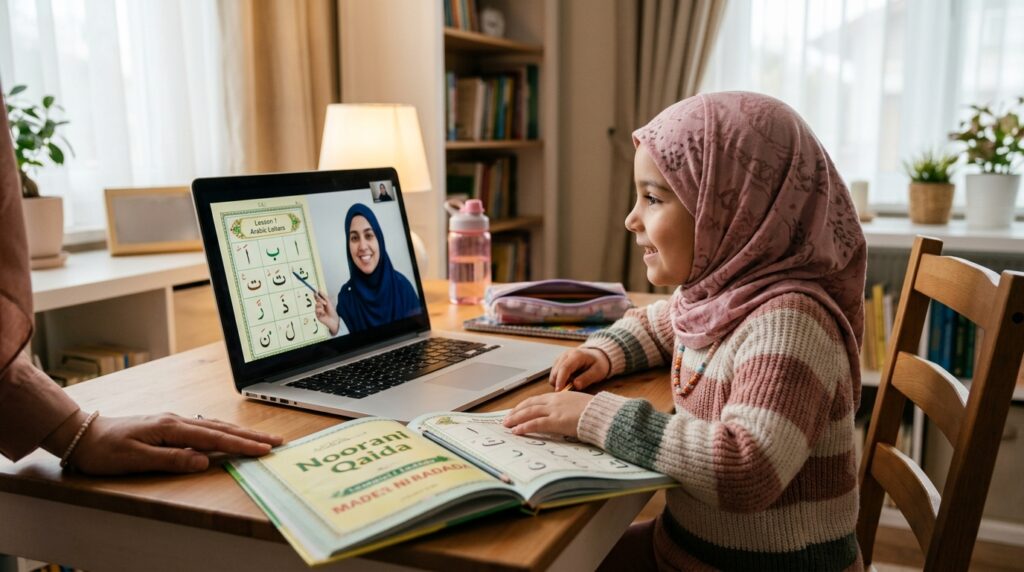
For parents who have not seen a Quran class before, here is what a typical 30-minute session looks like:
First 5 minutes — Warm up and review. The teacher begins by reviewing what was covered in the previous class. This builds retention and gives the teacher a sense of where the child is.
Next 15 minutes — New material. The teacher introduces 2-4 new letters or a new concept. The student repeats after the teacher, points to the letter, and practises reading with the teacher listening and correcting.
Final 10 minutes — Practice reading. The student reads through a short passage combining everything learned so far.
Homework. The teacher gives the child a specific small task: “Practise these three letters tonight with your parent.”
At every stage, correction is given — but a child corrected harshly learns to fear mistakes. A child corrected patiently learns to improve. Our teachers at Suffah are trained to correct with patience — it is one of the things parents consistently mention in their feedback.
Book a free trial class to see this in practice
What Comes After Madani Qaida?
Completing Madani Qaida is a genuine milestone — one that deserves to be celebrated.
After Madani Qaida, a student moves into Quran Reading with Tajweed — reading directly from the Mushaf, applying the rules of Tajweed to actual Quranic text. At this stage, the letters are already familiar and focus shifts to fluency and flow.
For children whose families want them to pursue Hifz (memorisation), Quran reading must be established first — a student who cannot read Arabic correctly cannot memorise correctly either.
The path is: Madani Qaida → Quran Reading with Tajweed → Hifz (if desired)
See our full range of Quran courses
How Parents Can Support Madani Qaida at Home
You do not need to know Arabic to support your child’s progress. Here is what actually helps:
Listen to your child practise. Even if you cannot correct pronunciation, your presence signals that this matters. Five minutes of listening while your child reads through their lesson is enormously motivating.
Make it a routine, not a task. Children who practise at the same time each day — after Asr, before dinner, before bed — build the habit without resistance.
Celebrate specific progress. “You read that whole line without stopping — that’s amazing” is more powerful than “good job.” Specific praise builds confidence alongside skill.
Stay in communication with the teacher. Ask monthly: “What should we be practising most this week?” Use the guidance you receive.
Play Quran recitation at home. Children absorb sounds passively. A home where recitation plays softly in the background produces children with better pronunciation instincts.
A Note for Parents Whose Children Are Struggling
Some children move through Madani Qaida more slowly than expected. This is normal — and it is not a reflection of intelligence or capability. Arabic is genuinely different from English, Urdu, or any other language most diaspora children grow up with.
If your child is struggling:
Talk to the teacher specifically: “Which stage is my child finding difficult, and what can we do at home?” A qualified teacher will have specific answers.
Reduce expectations of pace. A child who takes 12 months to complete Madani Qaida with solid foundations is in a far better position than one who rushes through in 6 months with gaps.
Check the home practice. In most cases, the single biggest difference between children who progress quickly and those who do not is what happens between classes.
Frequently Asked Questions
Most children begin between ages 4 and 7. The key indicator is readiness — can your child sit and focus for 20-30 minutes, follow simple instructions, and recognise basic shapes? For a full breakdown of readiness signs, read our guide on what age children should start learning the Quran (/what-age-should-children-start-learning-quran/).
Yes — Madani Qaida is appropriate for any beginner, regardless of age. Adults often move through it faster than children because their concentration and comprehension are stronger. Many of our adult students — including reverts learning for the first time — begin with Madani Qaida. See our courses for adults (/quran-courses/).
Neither is universally better. Both are excellent starting points. The right choice depends on the child and the teacher’s training. Our teachers will confirm in the free trial which is the right fit.
Two to three times per week is ideal for most children. Two classes per week with daily home practice typically produces better results than four classes per week with no home revision.
The Madani Qaida book itself — your teacher will guide you on the correct edition. In online classes, a digital version is often used and shared on screen. Beyond that, your child simply needs a quiet place to sit and a working internet connection.
Technically yes — but it is not recommended. Students who skip the Qaida stage almost always develop pronunciation habits that require significant correction later. The time spent on Madani Qaida is an investment, not a delay.
The Foundation Everything Else Is Built On
Madani Qaida is not a stepping stone to be rushed through. It is the foundation on which every aspect of your child’s Quran education will rest — pronunciation, Tajweed, fluency, confidence.
A child who builds this foundation slowly and correctly will read Quran beautifully for the rest of their life.
At Suffah Quran Academy, we do not rush Madani Qaida. We take it at exactly the pace each child needs — because we know what is built on top of it.
Book your child’s free trial class today (/free-trial/) No payment. No commitment. Just a real class with a patient teacher who knows exactly where to begin.