Estimated reading time: 11 minutes
It is one of the most common questions Muslim parents ask — and one of the most important.
Table of contents
- What Islamic Scholars Say About the Right Age
- The General Recommended Age Range
- Signs Your Child Is Ready — The 5 Key Indicators
- What About Children Who Start Later — Age 8, 10, or Older?
- The Role of the Home Environment
- What Happens in the First Quran Class
- Madani Qaida: The Right Starting Point for Almost Every Child
- A Note for Parents Who Are Worried They Started Too Late
- Frequently Asked Questions
- The Right Time Is the Time Your Child Is Ready
When should my child start learning the Quran?
Start too early and the child may feel overwhelmed before they’ve had a chance to develop a love for it. Start too late and years of learning time are lost. Getting the timing right — and the approach right — makes all the difference.
This guide gives you a clear, honest answer: what the scholars say, what child development tells us, and the practical signs that show your child is ready to begin.
What Islamic Scholars Say About the Right Age
There is no single fixed age mentioned in Islamic texts. What scholars across history have agreed on, however, is that Quran education should begin early — during childhood, when the mind is most receptive and habits are most easily formed.
The Prophet Muhammad ﷺ said:
“The best of you are those who learn the Quran and teach it.” (Sahih Bukhari)
This Hadith is recorded in Sahih Bukhari (Hadith 5027) — one of the most authenticated collections in Islamic scholarship.
This applies to all ages — but the wisdom of starting young is widely recognised. A child who grows up hearing and reciting the Quran develops a natural familiarity with Allah’s words that becomes part of who they are.
Historically, Islamic scholars began their students’ Quran education between the ages of 4 and 7. This aligns closely with what modern child development research tells us about language acquisition, memory formation, and habit-building in early childhood.
The General Recommended Age Range
For most children, the right time to begin structured Quran learning is between 4 and 7 years old.
Here is how that breaks down:
Ages 3–4: Listening and Exposure (Not Formal Study)
At this age, children are not yet ready for structured classes. But they are absolutely ready for exposure.
Playing Quran recitation at home, reciting short surahs together as a family, and making the Quran a natural part of daily life — this is the foundation that makes formal learning easier later.
This stage is about creating familiarity and love, not instruction.
Ages 4–5: Beginning Is Possible for Some Children
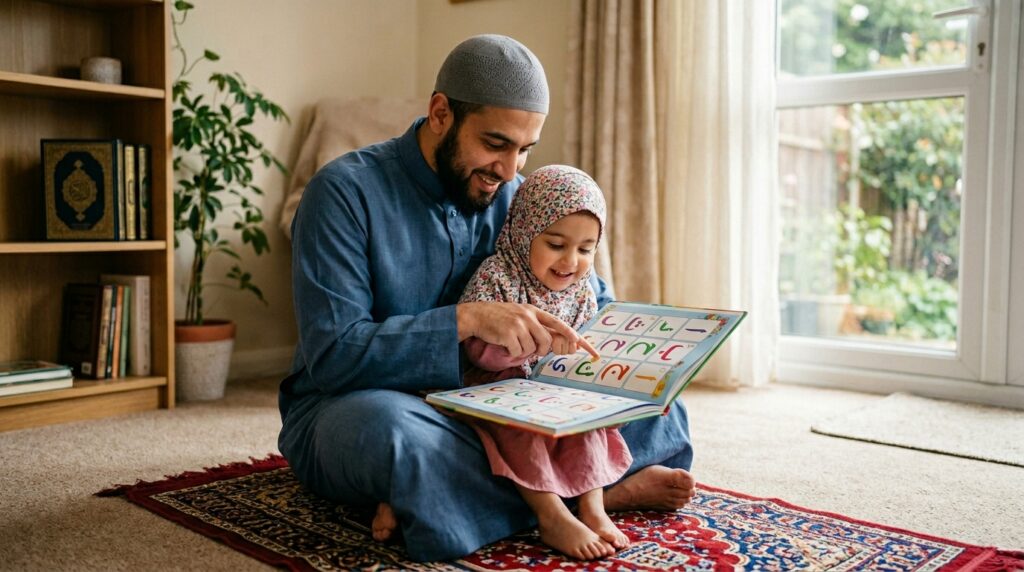
Some children at this age are ready to begin Madani Qaida — the structured starting point for learning Arabic letters and sounds.
The key word is some. At 4–5, readiness varies enormously between children. A child who can sit still for 20–30 minutes, follow simple instructions, and hold a pencil is likely ready to begin. A child who cannot yet do these things will struggle — and that struggle can create negative associations with Quran learning that are hard to reverse.
Do not force it at this age. If your child is not ready, another six months makes a significant difference.
Ages 5–7: The Ideal Starting Window for Most Children
This is the sweet spot for the majority of children. By age 5–6, most children can:
- Sit and focus for 20–30 minutes
- Distinguish between similar-looking shapes (crucial for Arabic letters)
- Follow a teacher’s instructions consistently
- Retain what they learn from one session to the next
Starting Madani Qaida at this age typically produces steady, confident progress — and children who start here often develop a genuine love for recitation because the pace matches their ability.
Child development research consistently identifies ages 5–7 as a critical window for language acquisition and literacy skills — documented extensively by UNICEF’s Early Childhood Development programme.
Ages 7 and Above: Still Excellent — Never Too Late
Children who begin at 7, 8, or even older are not at a disadvantage. In fact, older beginners often progress faster in the early stages because their concentration is stronger and their ability to understand instruction is greater.
If your child has not yet started, do not feel guilty. The best time to begin is now.
Signs Your Child Is Ready — The 5 Key Indicators
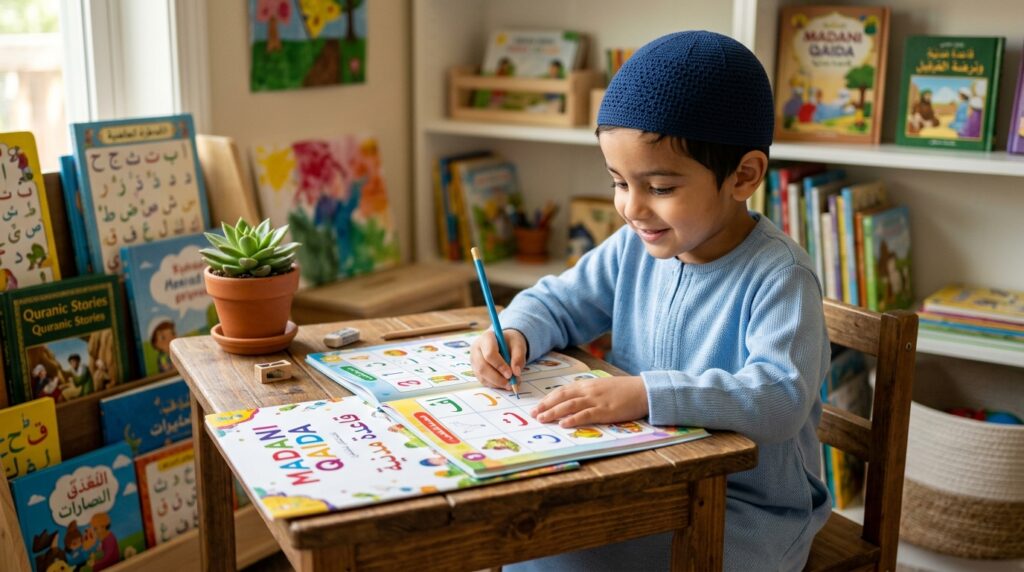
Age is a guide, not a rule. These five signs matter more than the number of candles on a birthday cake:
1. They Can Sit and Focus for 20–30 Minutes
A Quran class — even a short one for beginners — requires sustained attention. If your child cannot yet sit still and engage with a task for 20–30 minutes without becoming disruptive, formal classes will be frustrating for both the child and the teacher.
This does not mean your child must be perfectly still. It means they can engage with an activity for a sustained period.
2. They Recognise and Can Distinguish Shapes
Arabic letters are distinguished by their shape and the dots above or below them. A child who cannot yet reliably tell apart similar shapes will struggle to distinguish between letters like ب (ba), ت (ta), and ث (tha) — which differ only in the number and position of dots.
Basic shape recognition is the visual foundation of Arabic literacy.
3. They Can Follow Simple Instructions
In a Quran class, a teacher gives instructions: “Repeat after me,” “Point to the letter,” “Read this line.” A child who cannot yet follow basic sequential instructions will have difficulty keeping pace.
This is not about intelligence — it is about development. Most children reach this stage naturally between ages 4 and 6.
4. They Show Interest or Curiosity
This is not a requirement — but it is a gift when it is present. A child who has grown up hearing Quran at home, who asks questions about it, or who watches older siblings recite with curiosity, will begin formal learning with built-in motivation.
If your child has no exposure yet, begin creating that environment before starting classes. Even two weeks of playing Quran recitation at home can shift a child’s attitude significantly.
5. They Are Not Going Through a Major Transition
Starting school, a new sibling, moving house, a significant family change — these transitions take up enormous emotional energy in children. Beginning Quran classes during a period of significant upheaval often sets the child up for struggle.
Where possible, choose a stable, settled period to begin. The first few months of Quran learning set the tone for everything that follows.
What About Children Who Start Later — Age 8, 10, or Older?
Starting older is not a problem. It is simply a different starting point.
Children aged 8 and above typically move through Madani Qaida faster than younger children — their concentration is stronger, their memory is more developed, and their ability to understand the teacher’s explanations is greater.
What they may lack is the automatic, instinctive fluency that comes from learning a language or script very young. But this can absolutely be developed with consistent practice.
For older children who are starting for the first time, the key is not to rush. Beginning with Madani Qaida — even if the child feels they are “too old” for it — gives them the correct foundation that rushing past would deny them.
A child who builds slowly on solid ground always outperforms a child who races on a weak one.
The Role of the Home Environment
Formal classes are only part of the picture. What happens at home between sessions determines how quickly a child progresses.
Children learn Quran fastest when:
The Quran is present in daily life. Recitation playing softly in the home, parents reciting in front of their children, Quran present as a natural and beloved object — not something that only appears at class time.
Short daily revision is built in. Even 5–10 minutes of revision between classes — a parent listening to their child repeat what they learned — makes a significant difference to retention. Quran teachers recommend this universally.
Progress is celebrated, not just expected. A child who is praised specifically (“You pronounced that letter beautifully today”) develops confidence alongside skill. A child who only hears correction develops anxiety.
The teacher is consistent. One of the most underrated factors in children’s Quran progress is continuity with the same teacher. The relationship a child builds with their Quran teacher — the trust, the familiarity, the understanding of how that particular child learns — is itself a learning environment. Changing teachers frequently disrupts this.
What Happens in the First Quran Class
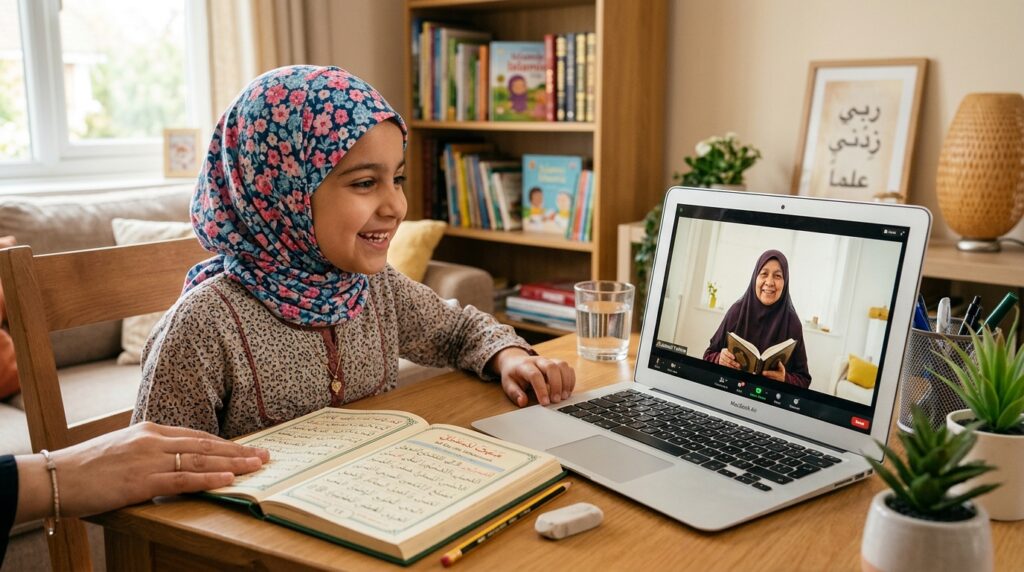
Knowing what to expect helps both parent and child feel calm about beginning.
For a child starting at the Madani Qaida stage, the first class typically involves:
Introductions. The teacher takes time to connect with the child — asking about their interests, making them feel at ease. A good Quran teacher does not dive straight into letters in the very first session.
The Arabic alphabet — an overview. The teacher may show the child Arabic letters, talk about the shapes, and gauge where the child currently is. This is assessment, not formal instruction yet.
A few letters introduced slowly. By the end of the first session, a child will typically have been introduced to the first 2–4 letters of the Arabic alphabet — their names, their shapes, and their basic sounds.
A short task for home. The teacher will suggest something simple to practice before the next class — recognising a letter, or repeating a sound a few times. This builds the habit of practice between sessions.
The first class should leave your child curious and calm — not overwhelmed. If it does not, that is feedback worth noting.
Madani Qaida: The Right Starting Point for Almost Every Child
Whatever age your child begins, they will almost certainly start with Madani Qaida.
Madani Qaida is a structured method for teaching Arabic letters, their sounds, and how they join together — designed specifically for beginners who have never encountered Arabic script before.
It moves step by step: individual letters, then letters with vowel marks, then joined letters, then short words, then short Quranic phrases. By the time a child completes Madani Qaida, they can read basic Arabic text — and are ready to begin Quran reading properly.
The time it takes varies by age and frequency of classes. A child attending two or three sessions per week typically completes Madani Qaida in 3–6 months.
Learn more about our Madani Qaida course for beginners →
A Note for Parents Who Are Worried They Started Too Late
If you are reading this and your child is 9, or 12, or older, and has not yet begun — please do not carry guilt about this.
Every child who begins learning the Quran today is doing so at the right time. There is no version of this where beginning is worse than not beginning.
What matters now is starting — consistently, with a qualified teacher, in an environment where your child feels supported and not pressured.
The Quran is not a race. It is a relationship. And every relationship begins with a first step.
Book a free trial class for your child today → No payment. No commitment. Just a real class with a real teacher who understands where your child is right now.
Frequently Asked Questions
It depends on the child, not the age. Some 4-year-olds are completely ready to begin Madani Qaida. Others are not yet there. The 5 readiness signs in this guide will tell you more than the birthday will. If your child cannot yet sit and focus for 20–30 minutes, wait a few more months and try again.
Not at all. Children who start at 8, 10, or even older often progress faster in the early stages because their concentration and comprehension are stronger. Begin with Madani Qaida regardless of age — it gives the correct foundation. Rushing past it creates problems later.
Both have a role. A qualified online teacher provides structured instruction, correct Tajweed, and professional guidance that most parents cannot provide. Home revision between classes reinforces what the teacher introduces. The ideal is both working together.
For young children (4–6), two classes per week is a gentle and effective start. For children aged 7 and above, two to three classes per week produces steady progress. Daily is ideal if the child is in a Hifz programme, but for general Quran reading, consistency matters more than frequency.
Resistance is common — especially in children who haven’t had much exposure to the Quran at home. Build familiarity first: play Quran recitation at home, recite short surahs together, make the Quran a warm and normal part of daily life. Then introduce the idea of classes gently. A free trial with a warm, patient teacher can shift a reluctant child’s attitude entirely.
Most Hifz programmes begin between ages 7 and 10, after the child can read Arabic with reasonable fluency. Beginning Hifz before a child can read properly creates significant difficulty later. Establish reading first — then consider memorisation.
The Right Time Is the Time Your Child Is Ready
There is no universally perfect age — but there is a window that works for most children, and there are clear signs that tell you when your child is in that window.
Watch for the signs. Create the environment. And when your child is ready, begin with a qualified teacher who will give them the foundation they deserve.
At Suffah Quran Academy, we work with children from age 4 through to adults — and we meet every student exactly where they are.